

Ligamentum Flavum Hypertrophy: Thickening, Causes & Care Options
Ligamentum flavum hypertrophy on an MRI report usually raises two questions: does it explain the back or leg symptoms, and does it mean surgery? A thickened ligamentum flavum takes up room at the back of the spinal canal. The nerves then have less space, most of all during long periods of standing or when leaning back. The scan shows the narrowing, and the examination shows how much it affects the nerves.
Symptoms tend to build with standing or walking: aching, heaviness, numbness or tiredness in the legs that eases with sitting or bending forward. Most of the causes are mechanical: stress on the spine over the years, past injuries, posture and daily habits. A disc that loses height also lets the ligament buckle inward. Age is one factor among several.
Care starts with an examination that compares the scan with how the back moves and how far the person can walk. Gentle, non-rotatory methods come first, used within what the patient can comfortably tolerate, and surgery is the last option. The sections below cover the causes, report terms such as "mild" and "bilateral", facet arthropathy, the care plan and when surgery is considered.
This guide, Ligamentum Flavum Hypertrophy: MRI, Symptoms & Treatment, is published by Chiropractic Specialty Center, Bukit Damansara (KL) main center: WhatsApp+60 17 269 1873 Call+603 2093 1000
Ligamentum Flavum Hypertrophy: Key Takeaways
| Point | What to know |
|---|---|
| On the MRI report | Ligamentum flavum hypertrophy means the elastic ligament along the back wall of the spinal canal has thickened. Reports usually list it beside a disc bulge and facet arthropathy at the same level. |
| Is it serious? | It is serious when the narrowing affects the nerves. "Mild" describes how the scan looks, not how much it matters: numbness, weakness or trouble walking can appear before much pain. |
| Can it be reversed? | No medication, injection or method of care is shown to reverse the scar-like thickening. Care aims at the room the nerves have during daily life. |
| Does it mean surgery? | Not on its own. Surgery is considered when nerve problems keep progressing or function is badly limited, after conservative care has had a fair trial. |
| What the tissue shows | In surgical samples, thicker ligaments held more scar tissue and fewer elastic fibers, and MRI showed the ligament thicker than the tissue actually removed. |
| Normal thickness | No single figure separates a normal ligament from a thick one. A lower back CT study concluded that 4 mm should not be the dividing line. In the neck, a cut-off of 1.71 mm separated narrowed canals from normal ones most accurately. |
| Care at CSC | Flexion-distraction, spinal decompression, non-rotatory chiropractic manipulation with the Activator instrument and soft-tissue work, combined with physiotherapy. Exercise starts once the body is ready, and deadlifts and free weights are avoided. |
Ligamentum Flavum Hypertrophy: Page Guide & Key Sections
- Ligamentum Flavum Hypertrophy Symptoms: What People Notice
- Arranging an Assessment for Ligamentum Flavum Thickening in KL
- What Causes Ligamentum Flavum Hypertrophy?
- Why the Ligamentum Flavum Is Frequently Misunderstood
- What Counts as Normal Ligamentum Flavum Thickness
- How the Ligament Changes with Breathing, Posture, and Load
- Facet Arthropathy & Ligamentum Flavum Thickening Together
- Why Thickness Measurements and Symptoms May Not Match
- Ligamentum Flavum Buckling or True Thickening?
- What “Indenting the Thecal Sac” and “Mild Hypertrophy” Mean
- Ligamentum Flavum Hypertrophy Treatment Starts With Mechanics
- Balanced Pathways After Assessment
- Ligamentum Flavum Hypertrophy, Disc Changes & Nerve Effects: Video Talk
- Related Educational Pages
- Frequently Asked Questions on Ligamentum Flavum Hypertrophy
- How to Read This Ligamentum Flavum Guide
- References and Evidence Context
Ligamentum Flavum Hypertrophy Symptoms: What People Notice
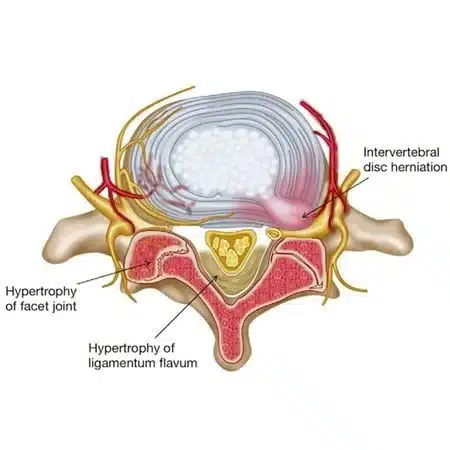
Ligamentum flavum hypertrophy causes symptoms only when the space it takes away starts to press on the nerves. So the same finding can be silent in one person and limiting in another. In the lower back, the usual signs are:
- Aching, heaviness or tiredness in the buttocks, thighs or calves that builds with standing or walking
- Numbness or tingling in one or both legs, sometimes with weakness
- Symptoms that settle after sitting down or bending forward, and an easier walk when leaning on a shopping cart
- Back stiffness on rising from a chair that eases after a few steps
- A walking distance that shrinks over months
When nerves are pinched, Yama Zafer, D.C., notes that pain increases, weakness sets in and long walks become hard. When the thickening sits in the neck, symptoms can travel down an arm instead.
Arranging an Assessment for Ligamentum Flavum Thickening in KL
Leg symptoms from a thickened ligamentum flavum can overlap with those from a disc, a facet joint, the hip or the circulation. So the first visit compares them. It checks walking tolerance and what eases it, posture, lumbar and hip movement, leg strength, reflexes and feeling. Any MRI or X-ray is reviewed against those findings before care options are discussed. Either Kuala Lumpur center can arrange it:
- Bukit Damansara (KL, main center): Call +603 2093 1000 or WhatsApp +60 17 269 1873 to see the Bukit Damansara / KL center.
- Bandar Sri Damansara (KL): Call +603 6262 5777 or WhatsApp +60 12 455 6939 to see the Bandar Sri Damansara center.
Directions and opening hours for both centers are on CSC Locations in Kuala Lumpur.
What Causes Ligamentum Flavum Hypertrophy?
In ligamentum flavum hypertrophy, most of the thickening is scar-like tissue. A study measured 308 ligaments on MRI and examined 20 removed at surgery. Thicker ligaments held more scar tissue and fewer elastic fibers, most of all along their back surface. A computer model showed the highest stress there, and the authors concluded that the scarring comes from mechanical stress that builds up over the years.
The disc in front matters too. Yama Zafer, D.C., describes the chain this way. A narrowed disc puts stress on the facet joints and lets the ligamentum flavum buckle into the canal.
In his view, the wear behind these changes comes mostly from daily mechanics: poor posture, long hours of sitting, bending and twisting, and heavy free-weight lifting. Past injuries, lifestyle and genetics play a part as well. Age is a factor, but not the only one, and he has seen healthy discs in people in their 80s. In his words, "You have to pay attention to the mechanics, because if you don't understand the mechanics, you'll not know what to do for it."
Why the Ligamentum Flavum Is Frequently Misunderstood
The ligamentum flavum lies deep inside the spinal canal, behind the spinal cord and nerve roots. It cannot be seen or felt from outside the body.
The disc, the facet joints, and the ligamentum flavum belong to the same spinal segment. They function as one connected system. Change in one structure affects the others. Understanding the unique properties of this ligament helps explain why some people have symptoms that do not match a single number on an MRI report.
What Makes the Ligamentum Flavum Unique
The ligamentum flavum contains a very high proportion of elastin: the protein that allows tissues to stretch and then return to their original shape. No other ligament in the body has quite the same combination of elasticity and location.
When healthy, the high elastin content lets it lengthen during forward bending and then spring back, helping control motion and maintain space inside the spinal canal. When it becomes thickened and less elastic, that protective ability is reduced.
What Counts as Normal Ligamentum Flavum Thickness
Thickness is not the same at every level of the spine, and there is no single agreed figure that separates a normal ligament from a thickened one.
In the lower back, 4 mm has often been used as the dividing line. A CT study compared 65 people with lumbar spinal stenosis and 150 people without its symptoms. It found the ligament thicker at L3-L4 and L4-L5 in the stenosis group, and thicker on the right side than the left. Its authors concluded that the borderline between a normal and an abnormal ligament should not be set at 4 mm.
In the neck, an MRI study measured the ligament at the C6-C7 level. It averaged about 1.4 mm in 87 people without canal narrowing and about 2.1 mm in 88 people with central narrowing. A cut-off of 1.71 mm separated the two groups most accurately.
These figures describe groups of people, not fixed rules. Actual values vary by person, age, exact level and the method used to measure, which is why a measurement on a report is read together with the examination.
How the Ligament Changes with Breathing, Posture, and Load
The ligamentum flavum is not rigid. It responds to pressure inside the spinal canal and to movement of the spine and rib cage.
During a breath in, the diaphragm moves down and pressure in the abdomen rises. Blood is pushed into the epidural veins that surround the spinal canal. This can temporarily increase pressure and change the tension or position of the ligament.
During a breath out, that pressure falls and the veins drain. A healthy ligament with good elastin content adapts smoothly to these shifts.
When the ligament becomes thickened and loses elasticity, it can no longer adapt as well. Under load or during spinal extension it may buckle inward into the canal. This can reduce space for the nerves even when a resting MRI measurement looked only moderately increased.
This difference between a lying-down MRI and real-world movement is sometimes called dynamic stenosis. It helps explain why symptoms can fluctuate with posture, walking, or breathing.
A Clinical Pattern That Often Points to Ligament Involvement
One pattern that raises the possibility of significant ligamentum flavum involvement is this:
A person has noticeable stiffness or difficulty rising from a chair or after prolonged sitting. After taking a few steps the stiffness eases and movement becomes easier.
This pattern can occur when a thickened, less elastic ligament reduces canal space in certain positions. Once the person begins to move, small changes in posture and load may temporarily improve the available space. The pattern is not diagnostic on its own.
Facet Arthropathy & Ligamentum Flavum Thickening Together
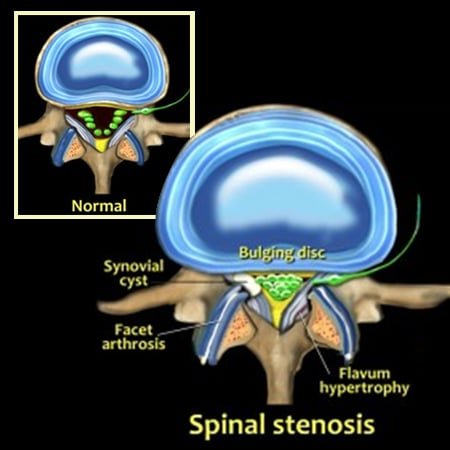
Facet arthropathy means wear and enlargement of the small facet joints at the back of the spine. The ligamentum flavum lies right beside them, so a report often lists both with a disc bulge, as in the drawing above. A typical line reads "diffuse disc bulge with ligamentum flavum hypertrophy and facet arthropathy". Diffuse means the bulge spreads around a wide part of the disc's edge.
Each one takes a little room from the canal or from the openings where the nerves leave the spine. Together they can narrow the space more than any one of them alone. That is why the report's summary line, such as "moderate canal stenosis", matters more than any single finding.
Related educational pages: slipped disc and disc changes and facet joint hypertrophy.
Why Thickness Measurements and Symptoms May Not Match
A thicker ligament on MRI does not automatically produce pain, numbness, or weakness. Some people with clear thickening have few symptoms. Others with more modest measurements have significant limitations.
Reasons for the mismatch include:
- Thickness is only one dimension. Shape, laterality, and relationship to the nerve roots also matter.
- Symptoms depend on the space available during standing and walking, which a lying MRI may not fully capture.
- Coexisting disc or facet changes can increase or decrease the clinical effect of the ligament.
- Individual nerve sensitivity and daily activity demands differ.
Ligamentum Flavum Buckling or True Thickening?
On an MRI report, a thick ligamentum flavum can mean two different things. The ligament may have truly grown thicker, with scar-like tissue building up over time. Or it may have folded inward, or buckled, as the disc in front of it wears and the space behind it shortens.
Think of a rubber band between two fingers. Move the fingers closer, and the band sags and bunches up without growing any bigger.
A 2024 study compared the ligament’s thickness on MRI with the real thickness of tissue removed during surgery in 70 people with spinal stenosis. The MRI made the ligament look thicker than it really was. Buckling added to that look, and buckled ligaments had less true thickening but more worn discs.
This matters because buckling depends partly on posture and on how worn the disc is. Leaning back and long periods of standing tend to fold the ligament inward, while bending forward stretches it out. That is why many people with this finding feel better sitting or leaning on a shopping cart. It is also why care at CSC leans on flexion-based methods and spinal decompression, with exercise added once the body is ready.
What “Indenting the Thecal Sac” and “Mild Hypertrophy” Mean
Reports often pair a thick ligament with words like “mild,” “indenting the thecal sac” or “narrowing the canal.” The thecal sac is the fluid-filled tube around the nerve roots. “Indenting” means the ligament touches the back of that tube and pushes its outline in a little.
“Mild” describes how the scan looks, not how much the finding matters. As Yama Zafer, D.C., explains, narrowing can affect the nerves, with leg numbness, weakness or trouble standing and walking, before much pain appears. What counts is the total space left in the canal. That depends on the ligament, the disc in front and the facet joints at the side, all together. Studies that measure the canal most often describe central stenosis as a front-to-back width under 10 millimeters or an area under 70 square millimeters.
The pattern of symptoms matters as much as the numbers. When the examination and the scan agree, care focuses first on positions that open the canal. Movement and strength work follow once the body is ready, and walking distance is checked regularly to track progress.
Ligamentum Flavum Hypertrophy Treatment Starts With Mechanics
Ligamentum flavum hypertrophy is primarily a mechanical issue. The thickened tissue physically occupies space inside the spinal canal or the neural foramina.
Oral medication and epidural steroid injections are aimed at pain and inflammation around the nerves, not at the thickened tissue itself. They may ease symptoms for a period of time, but they do not remove the tissue that narrows the canal. Injections also carry risks of their own, which the doctor offering them can explain. Yama Zafer, D.C., does not recommend steroid injections or surgery as a first choice.
The thickening is linked to mechanical stress on the segment. So care is aimed at the mechanics: how load is shared across the segment, how it moves and the condition of the soft tissues around it.
Why Gentle, Non-Rotatory Methods Suit a Thickened Ligament
Scarring in a thickened ligament is traced to mechanical stress that builds up over the years, most of all along its back surface.
Because repeated mechanical stress is linked to that scarring, care at CSC avoids sudden, forceful twisting of the spine (high-velocity rotatory manipulation). That matters most where the ligament is already thickened or the canal is clearly narrowed. Gentle, non-rotatory methods that respect the segment's mechanical limits are used instead.
Non-Surgical Methods That Focus on Load, Movement and Soft Tissue
After the examination, the care plan at CSC combines gentle methods such as:
- Flexion-distraction, a gentle method that flexes the lower back, the position that gives the nerves more room
- Controlled, non-rotatory spinal decompression when suitable, with lighter and shorter sessions for older patients
- Chiropractic manipulation that is non-rotatory, using the Activator instrument, so the spine is never twisted
- Gentle soft-tissue work, such as trigger point and myofascial therapy, with stretching delayed until the body is ready
- Physical methods such as therapeutic ultrasound, electrotherapy, shockwave therapy, high-intensity laser therapy and cold and heat therapy
- Balance and stability work, such as a rocker board, a wobble board, gym ball balance and Kegel exercises, once the body is ready
Care is kept within what the patient can comfortably tolerate, and the patient tells the clinician at once if anything hurts. Progress is checked by repeating the first visit's tests. Without improvement by the fifth session, the plan is reviewed, and by the tenth session the next step is discussed together.
At Chiropractic Specialty Center, chiropractors and physiotherapists plan this care together after the examination. The main center's page is Chiropractor in Kuala Lumpur with Physiotherapy.
Daily Habits for a Narrowed Spinal Canal
Yama Zafer, D.C., gives the same daily advice for any damaged lower back, and it matters even more when the canal is narrowed:
- Sitting: with acute back pain, stand up every 15 minutes and walk for 10 to 20 seconds. People without back problems should still take a break every 30 to 45 minutes.
- Sleep: at least six hours, on the side with a pillow that keeps the spine straight and a bolster between the knees. On the back, a bolster goes under the knees instead.
- Lifting: avoid it, and if it cannot be avoided, keep the load under 2 kg.
- Gym: discouraged at first; once stable, no deadlifts, free weights or leg presses.
Balanced Pathways After Assessment

Options commonly discussed after clinical and imaging review include:
Conservative and Supportive Approaches
Activity changes, postural awareness and, once the body is ready, carefully selected exercise under professional guidance are considered first when nerve problems are absent or mild.
Rehabilitative and Non-Invasive Care
Structured rehabilitation aimed at improving mobility, muscle support, and movement patterns may be appropriate.
Interventional and Surgical Pathways
When symptoms keep progressing, function is badly limited or nerve problems are present, medical specialists may discuss image-guided procedures or surgical decompression. Surgery has its place, but for disc problems Yama Zafer, D.C., says it "should be the last option. Exhaust conservative route."
Leg weakness that keeps getting worse should not be ignored. It calls for a careful assessment by a competent provider, and conservative care can continue only while the weakness itself is improving.
When a thickened ligamentum flavum narrows the spinal canal, report any change in your symptoms. If you have back or leg pain and develop new or worsening numbness around your genitals, between your genitals and anus, or around your anus, get urgent medical attention: a thorough assessment at a hospital emergency department straight away, within hours. New difficulty passing urine, or any loss of bladder or bowel control, needs the same urgent assessment. These symptoms have several possible causes. Some may call for an invasive procedure, but assessment does not automatically mean surgery is needed.
Ligamentum Flavum Hypertrophy, Disc Changes & Nerve Effects: Video Talk
In this in-depth session, Yama Zafer, D.C., explains how spinal disc changes, ligamentum flavum thickening, and joint stress can influence nerve function. The video breaks down how these structures work together, why symptoms may travel into the arms or legs, and how posture, sitting, and movement patterns affect the spine over time.
The page Back Pain to Leg Pain Video: Disc or Sciatica? lists every chapter of this talk.
Chapters on the Ligamentum Flavum
- 51:05 Sleep Position, Disc Height and L4-L5: As a disc loses height, the openings for the nerves narrow, the facet joints take more load and the ligamentum flavum can buckle inward. He explains that most forward bending happens at L4-L5.
- 57:13 Deadlifts, the Ligamentum Flavum and MRI: He advises against deadlifts and explains how the ligamentum flavum can thicken or buckle and narrow the space for the nerves. In his words, "Pain is not a yardstick. Pain is a symptom."
Planning a visit? You can review the current chiropractic price in Kuala Lumpur and physiotherapy fees in Kuala Lumpur before you come in.
Frequently Asked Questions on Ligamentum Flavum Hypertrophy
What does ligamentum flavum hypertrophy mean on my MRI report?
It means the radiologist saw thickening of the ligamentum flavum, the elastic ligament that lines the back wall of the spinal canal between the vertebrae. A thicker ligament leaves less room for the nerves, and reports usually describe it beside disc bulges and facet arthropathy at the same level. The finding on its own does not show how much it affects the nerves. So it is read together with the symptoms, the examination and the canal size at that level.
Is ligamentum flavum thickening serious?
It is serious when it narrows the canal enough to affect the nerves. The symptoms and the examination decide that, not the word on the report. Signs that it matters include a walking distance that keeps shrinking and numbness or weakness in a leg. With thickening in the neck, numbness or weakness can appear in an arm instead. New numbness around the genitals or anus, new difficulty passing urine, or loss of bladder or bowel control needs urgent medical attention at a hospital emergency department straight away, within hours.
What does bilateral ligamentum flavum hypertrophy mean?
Bilateral means both sides. The ligamentum flavum has a left and a right half at each level, and the report is saying both halves are thickened. A CT study of the lower back found the ligament thicker on the right side than the left on average. When both halves are thick, the canal can narrow from both sides at the back, and the report may also mention canal stenosis.
Why does ligamentum flavum hypertrophy show up so often at L4-L5?
In a study of 308 ligaments measured on MRI, the ligament thickened more over the years at L4-L5 and L3-L4 than at the other levels studied. Its computer model showed the highest stress on the ligament's back layer at L4-L5, about five times that on the front layer in forward bending. Yama Zafer, D.C., makes a related point in his talk: most forward bending happens at L4-L5. That, he explains, is why it and L5-S1 are where disc problems are most often found.
Can ligamentum flavum hypertrophy be reversed?
No medication, injection or method of care is shown to reverse the scar-like part of the thickening. Part of what an MRI shows can be buckling, the ligament folding inward, which changes with posture. Leaning back folds it in, and bending forward stretches it out. Care therefore aims at the room the nerves have during daily life, through posture, movement, the disc in front and the muscles around the spine. Progress is judged by repeating the examination's tests, such as walking distance, rather than by the millimeter figure on the report.
What exercises help ligamentum flavum hypertrophy?
With ligamentum flavum hypertrophy, exercise starts only when the body is ready, usually from about the fifth to seventh session. Yama Zafer, D.C., begins with wall-assisted squats, core canister breathing and, where the pelvic floor is weak, Kegel exercises. Strengthening of the glutes, hamstrings, calves and thighs follows, according to severity. For older patients with a narrowed canal, he adds more balance and stability work and delays stretching. Deadlifts, free weights, leg presses and hard hamstring stretches are avoided. Yoga must be avoided with a narrowed canal or a damaged disc. Its backbends fold the ligament further into the canal, and its twists strain the disc.
Does ligamentum flavum hypertrophy cause sciatica?
Ligamentum flavum hypertrophy can add to sciatica by narrowing the space for the nerve roots, often together with a disc bulge and facet changes. Yama Zafer, D.C., describes sciatica as a symptom rather than a diagnosis. In his experience, a damaged disc is involved to some degree in every case of sciatica. So the examination looks at the disc and the ligament together. Leg pain that builds with walking and eases with sitting points to a narrowed canal.
What should I do next?
Bring the full MRI report and the images to a registered practitioner who can examine you and compare the findings with your symptoms. Note how far you can walk before your legs tire and what eases it, such as sitting or leaning forward. That pattern and the examination guide the plan more than the millimeter figure does. Keep a short weekly record of the walking distance, so changes are easy to see.
How to Read This Ligamentum Flavum Guide
This guide explains ligamentum flavum hypertrophy for education. It cannot diagnose anyone or assess a person's own scan. So it does not replace an examination by a registered practitioner who can compare the MRI with the symptoms.
References and Evidence Context
| What the published evidence shows | Source |
|---|---|
| Thickening of the ligamentum flavum is part of what narrows the lumbar canal in spinal stenosis. In this study it came mainly from scar-like tissue. The authors traced it to mechanical stress building up over the years, most of all along the ligament's back surface and at L4-L5. | Sairyo et al., Spine, 2005 |
| Some of the thickening seen on MRI comes from the ligament buckling inward, which went with more worn discs, not only from true tissue growth. MRI showed the ligament thicker than the tissue removed at surgery. | Yabe et al., Spine, 2024 |
| In the lower back, the ligament was thicker at L3-L4 and L4-L5 in people with stenosis, and thicker on the right side. The authors concluded that 4 mm should not be used as the dividing line between a normal and an abnormal ligament. | Abbas et al., Spine, 2010 |
| In the neck, the ligament at C6-C7 averaged about 1.4 mm in people without canal narrowing and about 2.1 mm in people with central narrowing. A cut-off of 1.71 mm separated the two groups most accurately. | Jeong et al., Medicine, 2021 |
| The measures most often used for central lumbar stenosis are a front-to-back canal diameter under 10 mm and a cross-sectional area under 70 square millimeters. | Steurer et al., BMC Musculoskelet Disord, 2011 |
| A review of seven sets of guidance found that up to two-thirds of the listed warning signs of cauda equina syndrome describe a late stage that often cannot be reversed. It recommended referral at the early stage. | Todd, Br J Neurosurg, 2017 |
1. Sairyo K, Biyani A, Goel V, et al. Pathomechanism of ligamentum flavum hypertrophy: a multidisciplinary investigation based on clinical, biomechanical, histologic, and biologic assessments. Spine (Phila Pa 1976). 2005;30(23):2649-2656.
2. Yabe Y, Ishikawa K, Kurosawa D, Murakami E, Aizawa T. Buckling of the Ligamentum Flavum in Patients with Lumbar Spinal Canal Stenosis. Spine (Phila Pa 1976). 2024;49(17):E284-E290.
3. Abbas J, Hamoud K, Masharawi YM, et al. Ligamentum flavum thickness in normal and stenotic lumbar spines. Spine (Phila Pa 1976). 2010;35(12):1225-1230.
4. Jeong HW, Yi J, Lee S, et al. Prognostic value of cervical ligamentum flavum thickness as a morphological parameter to predict cervical stenosis. Medicine (Baltimore). 2021;100(34):e27084.
5. Steurer J, Roner S, Gnannt R, Hodler J; LumbSten Research Collaboration. Quantitative radiologic criteria for the diagnosis of lumbar spinal stenosis: a systematic literature review. BMC Musculoskelet Disord. 2011;12:175.
6. Todd NV. Guidelines for cauda equina syndrome. Red flags and white flags. Systematic review and implications for triage. Br J Neurosurg. 2017;31(3):336-339.
These references describe ligamentum flavum thickening, spinal stenosis and cauda equina syndrome in general. None of them evaluates care at Chiropractic Specialty Center.
The Author of Ligamentum Flavum Hypertrophy: MRI, Symptoms & Treatment
Ligamentum Flavum Hypertrophy: MRI, Symptoms & Treatment was written by Yama Zafer, D.C., who has 30+ years in chiropractic and physiotherapy and founded Chiropractic Specialty Center in Kuala Lumpur in 2006.
Last Updated: Ligamentum Flavum Hypertrophy: Thickening, Causes & Care Options
Ligamentum Flavum Hypertrophy: Thickening, Causes & Care Options was last reviewed and updated on October 9, 2026.
Dear Dr. Yama,
I have severe spine fracture at T11-12, DDD, spinal stenosis, osteoporosis and spondylolisthesis. My XR lumbar 6+ views with bending showed instability at L4-5 and L5-S1. Multilevel disc space tearing and listhesis. Degenerative changes of fact complexes. L4-5 is the worst with 6mm of anterolisthesis in flexion, 3-4 mm in extension. Retrolisthesis at L2-3, L3-4 is stable in flexion and extension.
My MRI without contrast showed L4-5 severe spinal stenosis with 70% canal narrowing, cysts in the spine, and moderate stenosis at L3-4 and L4-5, mild to moderate stenosis persists at L5-S1. Multilevel mild neural foraminal stenosis; with trace retrolisthesis of L3-L4. Grade I anterolisthesis of L4-L5, and L5-S1.
L3-L4 mild disc bulge. Mild spine stenosis. Mild bil. foraminal stenosis.
L4-L5 Grade I anterolisthesis. Disc bulge with superimposed post central disc protrusion. Advanced facet arthropathy. Severe spinal stenosis. Mild bil. foraminal stenosis.
L5-S1 Grade I anterolisthesis. Diffuse disc bulge. Advanced facet arthropathy.
Based on above information, can I stretch my piriformis muscle? What's your advice for me, please? Thank you for your time and comments!!
Please do not stretch the piriformis on your own for now. With slipping at L4-L5 and L5-S1 that moves 6 mm when you bend, a stretch that pulls on the hip and pelvis can move those segments further. In Yama Zafer, D.C.'s view, sciatica-type pain is a nerve issue, not a muscle issue, and your MRI shows severe narrowing at L4-L5 that can press on the nerves to the buttock and leg.
The osteoporosis and the T11-T12 fracture come first in any plan. Your doctor should manage the bone health, and any spinal care must be gentle and non-rotatory: no cracking, twisting or forceful pressure on the spine. Stretching waits until an examination shows your body is ready, and even then it stays gentle, never aggressive.
With instability, cysts and 70 percent narrowing at L4-L5, ask a spine surgeon what is causing your symptoms and what each option would do. Surgery has its place, and severity can change the usual order in which it comes last. Avoid bending, twisting and lifting, and stand up briefly every 15 minutes when sitting.
New numbness around the genitals or anus, new difficulty passing urine, or loss of bladder or bowel control needs urgent medical attention at a hospital emergency department straight away, within hours.
D10 D11 ligament flavor Mota ho gaya hai isko kaise theek Karen aur kitna time lagta hai theek nahin hai physiotherapy se theek ho jaega ya operation karna padega
The thickened ligament at D10-D11 does not thin again with physiotherapy, medication or any other treatment, so there is no time frame for reversing it. What care aims at is the room the spinal cord and nerves have during daily life, and that is what physiotherapy and gentle chiropractic care work on, when the examination shows they are suitable.
At D10-D11 the canal holds the spinal cord, so the first question is whether the cord is pressed. Weakness or stiffness in the legs, unsteady walking, numbness spreading up from the legs to the trunk, or a change in bladder or bowel control are signs of cord pressure, and they call for a neurosurgeon's assessment with your MRI. In that case an operation may be needed, because severity changes the usual order of care. If none of these are present, conservative care can be tried first; surgery should be the last option after a fair trial.
Whatever the plan, the spine must not be cracked or twisted, heavy lifting and bending are avoided, and care is kept within what you can comfortably tolerate. New numbness around the genitals or anus, new difficulty passing urine, or loss of bladder or bowel control needs urgent medical attention at a hospital emergency department straight away, within hours.
Sir
I am 36 and i am suffering
-Ligamentum Falvum hypertropy at lumbar
-central disc protrusion at L4-L5 with narrow of 4.2 mm
-mild at l3-l4 with narrowing of 9.4mm…
pls recommend me the best solution to go for as doctors recommended Surgery. I am avoiding surgery is it possible ??
Second is it chance that latter i have to prepare for l3-L4
Also give ur views on vertiflex procedure of surrgery
, I am from Agra ,India
Whether surgery can be avoided depends on how your nerves are doing, not on the millimeter figure alone. If strength, feeling, walking distance and bladder and bowel control stay stable, conservative care can be tried; Yama Zafer, D.C., says surgery should be the last option after conservative care has had a fair trial. If they get worse, surgery moves up.
L3-L4 at 9.4 mm is mild today. Whether it narrows further depends partly on daily mechanics: long sitting, bending, twisting and heavy lifting load the discs and the ligament, so the habits that protect L4-L5 protect L3-L4 as well.
About the procedure you mention: it places a spacer between the bony processes at the back of the spine to keep the segment from bending backward. It is an implant procedure, and whether it suits a 4.2 mm canal with a central disc protrusion is a question for your spine surgeon, together with what it is expected to improve and what happens if it does not.
New numbness around the genitals or anus, new difficulty passing urine, or loss of bladder or bowel control needs urgent medical attention at a hospital emergency department straight away, within hours.
I live in the El Paso Tx or Las Cruces New Mexico area and am trying to find the specialist as noted in your articles. Can you find or recommend any centers in these areas? Thank you
No, there are no centers in Texas or New Mexico. All of our centers are in Malaysia, and we cannot vouch for individual practitioners there, so here is what to look for instead.
Look for a registered practitioner whose first visit is an examination, not a treatment: how your spine moves, how far you can walk, and the strength, reflexes and feeling in your legs, compared with your MRI. For a thickened ligament and disc changes, the methods should be gentle and without twisting or cracking, such as flexion-distraction and low-force adjustments, combined with physiotherapy, and care should stay within what you can comfortably tolerate.
Ask how progress will be measured. A good plan repeats the first visit's tests, reviews the approach if there is no improvement by the fifth session, and discusses the next step by the tenth. Exercise should start only when your body is ready, and yoga should be avoided with a damaged disc. Surgery has its place, but it should be the last option after conservative care has had a fair trial.
New numbness around the genitals or anus, new difficulty passing urine, or loss of bladder or bowel control needs urgent medical attention at a hospital emergency department straight away, within hours.
thank you for your attention and comment .
I can share with you my symptoms for at least 15 mounts .
problem with long walking (pain in legs after and weakness in 2 legs.
I have neck pain but in the last year it was less chronic neck pain (but before i have the problem with lower extremity i have a chronic neck pain for 6 years .
I was have a trauma to the neck , but this was crash head in the backstroke swimming (to the wall of the pool ) in 2010.
Hello Zafer!
Thank you for this in-depth explanation. I’m a 39 year pharmacist, mother of 1, weight 165 lb, 5’7” that has dealt this chronic lower back pain for about 5 years. I have tried physical therapy and chiropractic therapy separately without success.
I recently pulled my lower back in November of this year while transferring a load of about 20 pounds which caused severe pain that radiated down my right buttock. MRI revealed several disc bulges at L3 to L5, disc dessication from L1 to L5, bilateral facet and ligamentum hypertrophy, mild neural foraminal stenosis, and compression of L5 nerve root.
I live in the United States and currently searching for an integrated care like you recommended above. My physiatrist recommended McKenzie exercise which is a bad idea and physical Therapy.
What would you recommend in terms of daily exercises or lifestyle changes (e.g sleeping on my back or side/belly, nutrition and supplements , walking/running, elliptical/stair climbers). Also, my job requires standing 90% of the time.
I’m also considering having another baby. Would this worsen my condition?
Thank you
Chiropractic and physiotherapy tried separately may be one reason care did not hold: Yama Zafer, D.C., recommends both combined in one plan. With the L5 root pressed after a lifting injury, that plan starts with an examination of the L5 root, the strength of the ankle and big toe and the feeling on the top of the foot, compared with the MRI.
Desiccation from L1 to L5 at 39 is not simply age. In his experience genetics, daily living, past injury and posture all bring it on far earlier than most people expect, so daily habits matter. Sleep at least six hours on your side, with a pillow keeping the spine straight and a bolster between the knees, or on your back with a bolster under the knees, never on your stomach. At work, stand tall with equal weight on both feet and knees unlocked, and change position often. Lifting stays light, and running and stair climbers wait until the examination shows your body is ready.
Exercise starts with gentle steps such as core canister breathing, Kegel exercises and wall-assisted squats, never deadlifts or yoga. No supplement repairs a disc. Pregnancy adds load to the lower back, so plan it with your doctor and keep care going alongside.
New numbness around the genitals or anus, new difficulty passing urine, or loss of bladder or bowel control needs urgent medical attention at a hospital emergency department straight away, within hours.
with MRI I have an hypertrophy of ligament flawvn at D5 D6 D8 D9 with legs impotence and pain. Is it a spinal stenosis
Yes. A thickened ligamentum flavum that narrows the canal is a form of spinal stenosis. At D5-D6 and D8-D9, in the mid-back, the canal holds the spinal cord itself, so narrowing there can press on the cord, and weakness and pain in the legs fit that.
This needs a prompt assessment by a neurosurgeon or spine surgeon with your MRI, including whether the report mentions any change inside the cord. Leg strength, reflexes, feeling and walking are checked, and the result decides the order of care: with cord pressure and leg weakness, a surgical opinion comes first, because severity can change the usual rule that surgery is the last option. Until then, the spine must not be cracked, twisted or pulled, and heavy lifting is avoided.
Weakness that keeps getting worse should not be ignored, and it calls for a careful assessment by a competent provider without delay. New numbness around the genitals or anus, new difficulty passing urine, or loss of bladder or bowel control needs urgent medical attention at a hospital emergency department straight away, within hours.
Hi Dr Yama
Iam in Brisbane Australia,
I have same diagnosis Ligamentum Flavum
after traying osteo, physio, acupuncture, no good
Iam reluctantly booked for surgery in 10 days to remove thickened ligament
have you got clinic in Australia as I would do anything to avoid surgery
I have sent your clinic email but no response
mile
We have no clinic in Australia; all of our centers are in Malaysia. We are sorry your email was not answered.
With surgery ten days away, the most useful step is to be clear with your surgeon about why it is planned. Ask what your examination shows, especially leg strength, reflexes, feeling and walking distance, and how the MRI compares with an earlier one. If your nerves are getting worse, surgery has its place and timing matters. If they are stable and the main problem is pain, you can ask whether a further fair trial of gentle conservative care is reasonable first; Yama Zafer, D.C., says surgery should be the last option for disc and canal problems.
Conservative care for a thickened ligament does not shrink the ligament itself; it works on the room the nerves have during daily life. In his approach that means flexion-based methods, such as flexion-distraction and gentle spinal decompression, non-rotatory manipulation with the Activator instrument, physiotherapy and daily habits: a break every 15 minutes while the pain is acute, at least six hours of sleep on your side or back, and no lifting or twisting. Whatever you decide, decide it with your surgeon rather than by cancelling at the last minute.
New numbness around the genitals or anus, new difficulty passing urine, or loss of bladder or bowel control needs urgent medical attention at a hospital emergency department straight away, within hours.
I am 38years old and have back pain with tingling and numb foot. I recently had an MRI of the Lumbar spine; below is my report; kindly assist.
The highlights of my MRI findings are as follows:
Multilevel ligamentum flavum hypertrophy and facet arthropathy. At L4-L5 level, mild central bulge causing minimal thecal sac indentation and minimal left lateral recess stenosis.
A numb foot with tingling is a nerve sign, so the examination should find which nerve root it follows. The L5 root supplies the top of the foot and the big toe, and the S1 root the sole and the outer edge. The L5 root passes the left lateral recess at L4-L5, where your report shows the bulge and the narrowing.
Which foot is numb matters: the report describes narrowing on the left, so numbness in the left foot fits it better than the right. The strength of the ankle and toes, the ankle reflex and the feeling in the foot are compared with the MRI, and if they do not match, the levels above and below are looked at again. Yama Zafer, D.C., notes that a mild finding on a scan can still affect a nerve before much pain appears.
Care for a disc problem like this is gentle, without twisting or cracking the spine, kept within what you can comfortably tolerate, with flexion-distraction and gentle decompression where suitable, and exercise added only when your body is ready. Stand up and walk briefly every 15 minutes while the pain is acute, and avoid bending, twisting and lifting.
New numbness around the genitals or anus, new difficulty passing urine, or loss of bladder or bowel control needs urgent medical attention at a hospital emergency department straight away, within hours.
Hi! I just had an MRI that says my Flavun thingy is thickened. Where is your nearest Center in southwest USA? Oh plz help! Thanks
Cathy T
There are no centers in the United States. All of our centers are in Malaysia.
The finding itself is easier to understand than the report makes it sound. The ligamentum flavum is an elastic ligament along the back wall of the spinal canal, and a thickened one takes up some of the room the nerves use. Whether it matters depends on whether it presses on them, and that is decided by your symptoms and an examination, not by the wording of the report. Yama Zafer, D.C., explains that the thickening comes mostly from mechanical stress over the years, from posture, sitting, bending, twisting and heavy lifting, with a narrowed disc adding to it; age is a factor, but not the only one.
Signs to watch are legs that ache, tire or go numb with standing or walking and ease with sitting, a walking distance that shrinks, or weakness. If any of these appear, see a spine specialist with your MRI. Care, when it is needed, should be gentle, without twisting the spine, and within what you can comfortably tolerate.
New numbness around the genitals or anus, new difficulty passing urine, or loss of bladder or bowel control needs urgent medical attention at a hospital emergency department straight away, within hours.
Respected sir, is collagen intake harmful to patients with ligamentum flavum hypertrophy? And if so, which supplements should we take in ligamentum flavum hypertrophy?
There is no evidence that eating collagen thickens the ligamentum flavum. Collagen taken by mouth is broken down in digestion like any other protein, and the scar-like tissue in a thickened ligament is traced to mechanical stress that builds up over the years, most of all along its back surface, not to diet.
No supplement has been shown to thin the ligament either, so the effort is better spent on the mechanics: posture when sitting and standing, a break every 15 minutes while back pain is acute, at least six hours of sleep on your side or back, no deadlifts, free weights or yoga, and no lifting in poor postures. If you take supplements for other reasons, check them with your doctor, especially alongside other medicines.
Care for the narrowing itself starts with an examination and an MRI review, then gentle methods without twisting, kept within what you can comfortably tolerate, with exercise added once the body is ready. New numbness around the genitals or anus, new difficulty passing urine, or loss of bladder or bowel control needs urgent medical attention at a hospital emergency department straight away, within hours.
Hi Doctor Yama,
My daughter is a chiropractic doctor in Indianapolis, Indiana, in the US. She has suggested that I contact you. I have had pain in both ankles for eight weeks. The pain worsens after walks or if I stand for 10-15 minutes.
I am a retired pain management physician. I have had Epidural steroid injections twice, but it has not helped. X-rays and MRIs have been taken. The MRI shows canal stenosis, disc bulge, facet hypertrophy, and ligamental hypertrophy. What is your advice for me?
Vinu Patel MD
Ankle pain on both sides that builds after 10 to 15 minutes of standing or walking can come from a narrowed lumbar canal, but it is not the usual pattern, which is heaviness or aching in the buttocks, thighs or calves. So the examination should test both: the strength, reflexes and feeling of the L4, L5 and S1 roots in each leg, and the ankles and feet themselves, with the circulation of the legs checked as well, since standing and walking also bring on vascular and joint pain.
Epidural injections are aimed at pain and inflammation around the nerves, not at the disc, the facet joints or the thickened ligament that narrow the canal, so two without benefit neither confirm nor rule out the canal as the source. If it is the source, care would lean on flexion-based methods, such as flexion-distraction and gentle spinal decompression, with non-rotatory manipulation and physiotherapy, kept within what you can comfortably tolerate and checked against the first visit's tests.
Note what eases the ankles: if sitting or bending forward eases them, the canal is more likely; if simply standing still eases them, other causes come first. New numbness around the genitals or anus, new difficulty passing urine, or loss of bladder or bowel control needs urgent medical attention at a hospital emergency department straight away, within hours.
Sir
I am 36 and i am auffering from central disc protrusion along with ligamentum falvum hypertrophy which creating canal narrowing to 4.2 mm at L4-L5 and mild atl3-l4 with narrowing of 9.4mm… pls recommend me the best solution to go for as doctors recommend Surgery , I am from Agra … pls also suggest exercise nd precautions
A canal of 4.2 mm at L4-L5 is severe narrowing, much tighter than the 9.4 mm at L3-L4. At 36 it is worth asking your surgeon whether your canal was narrow to begin with, because that changes how much room the disc and the ligament can take before the nerves are pressed.
No treatment is the best for everyone; the choice depends on what the examination finds. If your leg strength, reflexes, feeling and bladder and bowel control are normal and stable, a fair trial of gentle conservative care is reasonable, and Yama Zafer, D.C., says surgery should be the last option. If any of them is getting worse, the order changes and the surgical opinion comes first.
Precautions while you decide: avoid bending, twisting and lifting, and keep any load under 2 kg; no deadlifts, free weights, leg presses or yoga; stand up and walk briefly every 15 minutes while the pain is acute; and sleep at least six hours on your side with a bolster between the knees. Exercise starts only when your body is ready, under supervision, with gentle steps such as wall-assisted squats and core canister breathing.
New numbness around the genitals or anus, new difficulty passing urine, or loss of bladder or bowel control needs urgent medical attention at a hospital emergency department straight away, within hours.
Howdy, My wife has this condition primarily L3-L4 and L4-L5 and additional mild issues L1 through L-3. The orthopedic doctor prescribed McKenzie exercises, pain meds, and, if necessary, an injection and down the road surgery. I think it's a bad idea! Proper exercise is the best approach. Is there anyone you know of in Tallahassee, Florida, she could go to?
Thanks,
Her Husband
We do not know a practitioner in Tallahassee to refer to, and all of our centers are in Malaysia, but good care has the same shape anywhere.
With a thickened ligament and disc changes at L3-L4 and L4-L5, Yama Zafer, D.C., starts with an examination and an MRI review, then uses gentle methods without twisting: flexion-distraction, spinal decompression where suitable, non-rotatory chiropractic manipulation with the Activator instrument, and physiotherapy. Exercise is core to recovery, but only when the body is ready, usually from about the fifth to seventh session, and it starts gently, with wall-assisted squats and core canister breathing. Exercises that bend the lower back backward again and again can fold the thickened ligament further into the canal, so ask how any program suits her narrowed canal before she starts it.
He does not recommend steroid injections or surgery as a first choice; surgery has its place, but it should be the last option after conservative care has had a fair trial. Daily habits matter as much: a break every 15 minutes while the pain is acute, at least six hours of sleep on her side or back, and no lifting, deadlifts or yoga.
New numbness around the genitals or anus, new difficulty passing urine, or loss of bladder or bowel control needs urgent medical attention at a hospital emergency department straight away, within hours.
I read your website about spine issues related to ligamentum flavum hypertrophy.
I am 31 years old; I had an accident and injured my neck (the soft tissue of my neck ). I started to have symptoms about three mounts ago. Now years after the trauma is causing severe chronic neck due to degenerative changes, including damage to my ligament flavum (hypertrophy and buckling of ligamentum flavum).
My ligamentum flavum hypertrophy involves the C3-C4 segments of my neck, causing compression of my spinal cord and nerves from the center to the left.
MY symptoms include neck pain, pins & needles, and tingling in the legs and hand. The pins & needles started last week. I am also experiencing pins & needles in my trunk, along with pain in the chest.
Moreover, my blood pressure increased with the systolic pressure ranging between 170 and 190m, but it is lower now, fluctuating between 110 and 130.
I like to find out if my condition is treatable without surgery, as I am not looking forward to neck surgery. Also, is there a way to help repair my Myelomalacia without getting surgery?
thanks
New pins and needles in the legs, a hand and a band across the trunk, with cord compression at C3-C4 and myelomalacia on the MRI, mean the spinal cord itself is affected. That needs a neurosurgeon's assessment promptly, not a wait to see how it goes. Myelomalacia means the cord tissue has been harmed by the pressure, and no treatment repairs it; the aim is to stop further harm.
For disc and ligament problems, surgery should be the last option after conservative care has had a fair trial, but cord compression with new symptoms is a situation where severity changes the order of care. Ask the surgeon what the latest MRI shows compared with the earlier one, and what each option is expected to do. While the cord is pressed, the neck must not be cracked, twisted or pulled, and any other care should wait for the surgeon's advice.
Chest pain needs a medical check straight away, and blood pressure readings of 170 to 190 need your doctor's review, because both can have causes outside the spine.
New clumsiness of the hands, unsteady walking, or any change in bladder or bowel control needs urgent medical attention at a hospital emergency department straight away, within hours.
I learned a lot from reading your website. Thank you for the information. I receive no treatment, just drugs from Drs, and I've been in pain for 20 years. Is it too late for me? Thanks, Martha from California.
No, it is not too late to look for the cause. Twenty years of pain with medication alone usually means the source has not been fully assessed, and an examination can still find out which structures are involved and what loads them during the day.
Yama Zafer, D.C., says there is no such thing as normal back pain: pain is a symptom, and ignoring it lets a problem progress. A first visit should check how you move, stand and walk and the strength, reflexes and feeling in your legs, and compare those findings with an MRI where a disc problem is suspected. Care for a long-standing problem is gentle, without twisting the spine, kept within what you can comfortably tolerate, and builds strength only when your body is ready. Progress is checked against the first visit's tests, and without improvement by the fifth session the plan is reviewed.
The habits of the other 22 hours of the day matter as much as any session: posture when sitting and standing, a break every 15 minutes while pain is acute, at least six hours of sleep on your side or back, and no lifting in poor postures. All of our centers are in Malaysia, so look for care near you that works this way.
New numbness around the genitals or anus, new difficulty passing urine, or loss of bladder or bowel control needs urgent medical attention at a hospital emergency department straight away, within hours.
I had fusion surgery seven years ago for c4c5, and now I have ligament flavum thickening on c5c6 . Can you help me?
A fusion stops movement at C4-C5, so the levels next to it, C5-C6 among them, take more of the neck's bending and turning. That extra load over the years is a common reason for changes such as a thickened ligamentum flavum to appear at the level below a fusion.
What matters first is whether the thickening presses on the spinal cord. Clumsy hands, dropping things, unsteady walking, symptoms in both arms or in the legs, or a change in bladder control call for a prompt review by your spine surgeon with a current MRI. With a fusion above and a possible cord narrowing, the neck must not be cracked, twisted or pulled.
If the cord is clear and the symptoms are neck pain, or pain down one arm, gentle care is reasonable: non-rotatory methods such as the Activator instrument, gentle soft-tissue work and physiotherapy, kept within what you can comfortably tolerate. Daily habits protect the level below the fusion: screens at eye level, the phone held up rather than the head bent down, a break every 15 minutes while the pain is acute, and a pillow that keeps the neck level with the spine. Surgery has its place, but it should be the last option after conservative care has had a fair trial.
I’m 77. I have all of the above. Do you have any office near the Lancaster, Pennsylvania, Downingtown, Pennsylvania, Reading Pennsylvania areas
No, there are no offices in Pennsylvania. All of our centers are in Malaysia.
At 77, care for a narrowed canal is gentler, and Yama Zafer, D.C., adapts it in several ways: more change to daily habits, stretching delayed, more balance and stability work, and lighter, shorter spinal decompression sessions where decompression is used. Methods are non-rotatory, so the spine is never twisted, and care is kept within what you can comfortably tolerate.
Position helps with this finding. Leaning slightly forward opens the canal, which is why walking with a shopping cart or a wheeled walker is often easier than walking unaided, and short rests before the legs tire help you keep walking. Balance matters as much as the pain at your age: loose rugs, cords and poor lighting at home are worth fixing, and any medicine that causes drowsiness is worth reviewing with your doctor.
Age alone does not decide whether surgery is right; your general health and how much your walking is limited do. Surgery has its place, but it should be the last option after conservative care has had a fair trial.
New numbness around the genitals or anus, new difficulty passing urine, or loss of bladder or bowel control needs urgent medical attention at a hospital emergency department straight away, within hours.
Do you have any centers in India where we can go for treatment?
No, there are no centers in India. All of our centers are in Malaysia.
Good care for a spinal problem has the same shape wherever it is given. The first visit is an examination, not a treatment: when the symptoms began, what changes them, how the spine moves, and, where pain travels into a leg or arm, the strength, reflexes and feeling of that limb. When a disc problem is suspected, an MRI confirms it rather than guessing a final diagnosis.
The plan should use gentle methods without twisting or cracking for a damaged disc, keep care within what you can comfortably tolerate, and add exercise only when your body is ready. Progress is checked by repeating the first visit's tests: without improvement by the fifth session the plan is reviewed, and by the tenth session the next step is discussed together. Be careful with large prepaid courses before an examination has been done.
Daily habits matter as much as the sessions: stand up and walk briefly every 15 minutes while the pain is acute, sleep at least six hours, and avoid bending, twisting and lifting. New numbness around the genitals or anus, new difficulty passing urine, or loss of bladder or bowel control needs urgent medical attention at a hospital emergency department straight away, within hours.
I am also having the same back problem with pain shooting down my buttocks and legs. What can be done? Please advice.
Pain that shoots into the buttocks and down the legs usually comes from nerves pressed in the lower back. Yama Zafer, D.C., describes sciatica as a symptom rather than a diagnosis, and in his experience a damaged disc is involved to some degree in every case, often together with a thickened ligament or enlarged facet joints, as on this page.
The first step is an examination: how far down each leg the pain reaches, whether it builds with walking and eases with sitting, and the strength, reflexes and feeling in both legs. An MRI is used when a disc problem is suspected. With pain in both legs, the canal itself may be narrowed, so both sides are checked.
Until then, avoid bending, twisting, lifting and any exercise that brings on pain. Stand up and walk briefly every 15 minutes while the pain is acute, and sleep at least six hours on your side with a bolster between the knees, or on your back with a bolster under the knees. Care for a disc problem is gentle, without twisting and within what you can comfortably tolerate, with exercise added when your body is ready.
New numbness around the genitals or anus, new difficulty passing urine, or loss of bladder or bowel control needs urgent medical attention at a hospital emergency department straight away, within hours.
Sir, do you have any branches in India?
No, there are no branches in India. All of our centers are in Malaysia.
A good step where you are is to collect your MRI as images, not only the typed report, and to ask that four things are stated: the canal size in millimeters at the narrowest level, which structures narrow it (the disc, the ligamentum flavum, the facet joints or a mix of them), whether a nerve root or the spinal cord is pressed, and whether the cord shows any change inside it. Those answers shape the plan more than the choice of clinic.
When you choose care, look for an examination before any treatment, gentle methods without twisting or cracking for a damaged disc, care kept within what you can comfortably tolerate, and progress checked against the first visit's tests. If there is no improvement by the fifth session, the plan should be reviewed. Surgery has its place, but for disc problems it should be the last option after conservative care has had a fair trial.
New numbness around the genitals or anus, new difficulty passing urine, or loss of bladder or bowel control needs urgent medical attention at a hospital emergency department straight away, within hours.
Sir, I am suffering from degenerated disc disease involving c3-4,c4-5. I also have ligamentum flavum hypertrophy at c4-c5. What is the solution, sir, as I am in pain daily?
In the neck, a thickened ligamentum flavum takes room from the canal that holds the spinal cord, so the first step is to find out whether the cord is affected. The signs are not neck pain. They are clumsy hands, dropping things, trouble with buttons or handwriting, unsteady walking, symptoms in both arms or in the legs, and any change in bladder control. If any of these are present, see a neurosurgeon with a current MRI before any treatment, and the neck must not be cracked, twisted or pulled.
If none are present and the pain stays in the neck, or travels down one arm, gentle care is reasonable. For damaged discs at C3-C4 and C4-C5, Yama Zafer, D.C., uses care without twisting the spine, such as chiropractic manipulation that is non-rotatory with the Activator instrument, together with physiotherapy and gentle soft-tissue work. Care is kept within what you can comfortably tolerate, and progress is checked against the first visit's tests: without improvement by the fifth session, the plan is reviewed.
Looking up for long periods narrows the canal further, so screens belong at eye level and overhead work is limited. No treatment shrinks the thickened ligament itself, so the aim is the room the nerves and the cord have during daily life. Surgery has its place, but it should be the last option after conservative care has had a fair trial.
Adding the daily side, since that is where most of the 24 hours are spent.
Sleep at least six hours, on your side or back, with a pillow that keeps the neck level with the rest of the spine. There is no perfect pillow: a rolled towel under the neck, or a pillow with a thin and a thick side, can work. Do not sleep on your stomach, which holds the neck turned for hours.
At a desk, raise the screen so your eyes are slightly below its top edge, hold the phone up rather than bending the head down, and stand up and walk for 10 to 20 seconds every 15 minutes while the pain is acute. Avoid long periods of looking up, and do not let anyone crack, twist or yank your neck.
Exercise for the neck and shoulder blades starts only when your body is ready, as your clinician advises. Before your next visit, note how long you can sit at a screen before the pain builds and how far it travels into the arm, so progress can be measured.
If your hands become clumsy, your walking unsteady or your bladder control changes, stop treatment and see a neurosurgeon promptly.
Do you have NSD Therapy clinics in the East San Francisco Bay Area in California> I require my multi-level moderate to severe mid-Lumbar (worst at L3-4, based on MRI). Also, I have foraminal stenosis due mostly to Ligamentum Flavum, epidural lipomatous. MRI also showed facet hypertrophy and disc bulging. Symptoms include moderate achy/diffuse LBP, mild to moderate right shooting pain in the buttocks. Also suffer from leg pain, weakness, numbness, and tingling coming from L2-L3, L4-5 & L5-S1. Tinginglin is the greatest in toes (both sides). No pain with Valsalva, no claudication symptoms, no acute progressive weakness or bowel & bladder issues or incontinence, but occasional bowel urgency. Thank you1 com
No, we have no center in California. All of our centers are in Malaysia.
With findings at several levels, the examination decides which ones explain your symptoms. Tingling in the toes on both sides, weakness and right buttock pain point to more than one nerve root, so the strength, reflexes and feeling of each root are compared with the MRI level by level. Your report also names epidural lipomatosis, extra fat around the nerve sac. It has been linked with long courses of steroid medication and with body weight, so it is worth raising with your physician.
For a canal narrowed by the ligament, the facet joints and the disc together, care at our centers leans on flexion-based methods, such as flexion-distraction and gentle spinal decompression, and on non-rotatory chiropractic manipulation with the Activator instrument. The spine is never twisted, and care is kept within what the patient can comfortably tolerate. Surgery has its place, but it is the last option after conservative care has had a fair trial.
Weakness that keeps getting worse should not be ignored. It calls for a careful assessment by a competent provider, and conservative care can continue only while the weakness itself is improving. The occasional bowel urgency you mention should be reported to your physician. New numbness around the genitals or anus, new difficulty passing urine, or loss of bladder or bowel control needs urgent medical attention at a hospital emergency department straight away, within hours.
Hello. I have multiple degenerative disc diseases and ligamentum flavum hypertrophy. Do you have any offices in the Tampa Bay, Florida area?
No, there are no offices in Florida. All of our centers are in Malaysia.
With degenerative disc disease and a thickened ligamentum flavum together, the canal can narrow from the front and the back at once. Yama Zafer, D.C., explains it this way: a disc that loses height puts more load on the facet joints and lets the ligament buckle into the canal. So whoever you see locally should begin with an examination that compares the MRI with how you walk, stand and move, and with the strength, reflexes and feeling in your legs.
In that care, look for gentle, non-rotatory methods for a damaged disc, with no cracking or twisting of the spine, care kept within what you can comfortably tolerate, and progress checked against the first visit's tests, with the plan reviewed if there is no improvement by the fifth session. Exercise should start only when your body is ready, and yoga must be avoided with damaged discs. Surgery has its place, but for disc problems it should be the last option after conservative care has had a fair trial.
Daily habits matter as much as any treatment: stand up and walk briefly every 15 minutes while the pain is acute, sleep at least six hours on your side with a bolster between the knees, and avoid lifting. New numbness around the genitals or anus, new difficulty passing urine, or loss of bladder or bowel control needs urgent medical attention at a hospital emergency department straight away, within hours.
I am suffring from lingament flames d10 d11 on 20 years I am 56 year old present I am on wheel chair legs pain no movement. stesses right hand weakness left shoulder pain
Loss of movement in both legs with a thickened ligament at D10-D11 means the spinal cord has been pressed at that level for a long time. That needs care from a neurosurgeon and a rehabilitation specialist, and the spine must not be cracked, twisted or pulled.
The most urgent point in your message is the weakness in your right hand. The D10-D11 level supplies the trunk and the legs, not the arms, so hand weakness and shoulder pain point to the neck. Ask for an MRI of the neck as well as the mid-back, and a neurosurgical assessment, because your arms are what you rely on now, and pressure in the neck should be looked for before more strength is lost.
A rehabilitation specialist can also help with what matters every day in a wheelchair: skin care to prevent pressure sores, bladder and bowel care, keeping the joints of the legs from stiffening, a seating check, and protecting the shoulders, which carry much more load when you push and transfer. Your left shoulder pain may come from that extra load.
Weakness that keeps getting worse should not be ignored, and it calls for a careful assessment by a competent provider without delay. New numbness around the genitals or anus, new difficulty passing urine, or loss of bladder or bowel control needs urgent medical attention at a hospital emergency department straight away, within hours.