

L3-L4 Spine Care in Kuala Lumpur
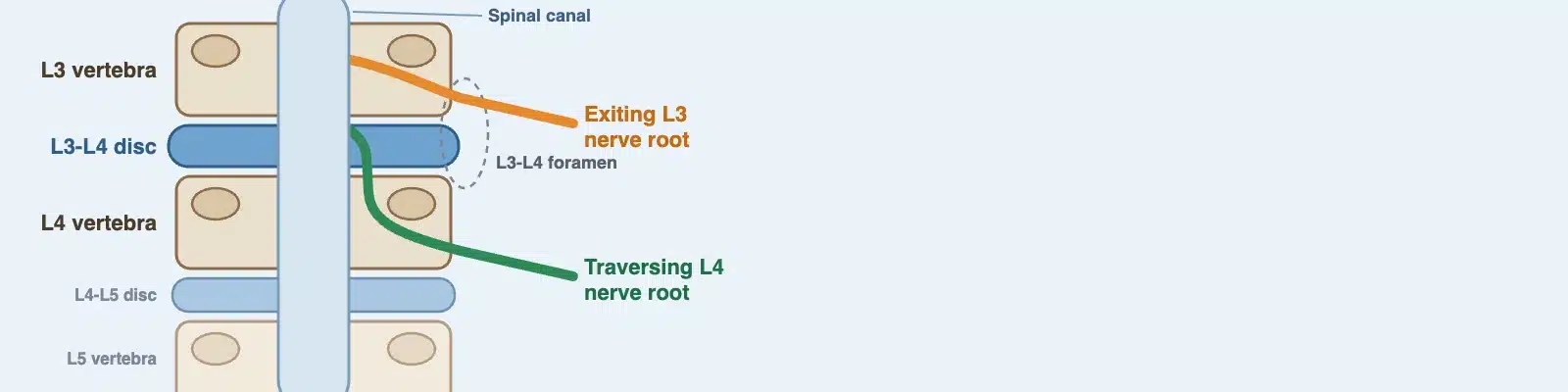
L3-L4 is the spine level in the middle of the lower back, where the third and fourth lumbar vertebrae meet over one disc. Scan reports may write it as L3/4 or L3-4. The L3 nerve root leaves the spine here, and the L4 root runs down past the disc. They serve the front of the thigh, the inner knee and shin, and the muscles that straighten the knee.
Trouble at this level can show as a stiff, aching middle of the lower back. Pain, tingling or numbness may also spread over the front of the thigh and around the knee. Most tears and wear-related changes, in my view, follow an injury or harmful strain, sudden or repeated. In my Back Pain to Leg Pain talk, I note that slouched sitting can bring extra weight down onto this level.
By my definition, a true disc bulge here does not press on the L3 or L4 root. Care starts with a full assessment, adding an MRI when a disc problem is suspected. Chiropractors and physiotherapists then plan care together, never twisting a spine with a damaged disc. The sections below cover each disc stage, care, daily habits and what to avoid.
This guide, L3-L4 Spine: Location, Meaning, Nerves and Disc Bulge, is published by Chiropractic Specialty Center, Bukit Damansara (KL) main center: WhatsApp+60 17 269 1873 Call+603 2093 1000
L3-L4 Spine: Key Takeaways
| Question | Short answer |
|---|---|
| Where is L3-L4 on the spine? | Near a line felt across the tops of the hip bones. In one study of 75 adults with chronic low back pain, that line pointed to L3 or L3-L4 in 77% (Chakraverty and colleagues, 2007). |
| What nerves does L3-L4 affect? | The L3 and L4 roots both feed the femoral nerve, which works the quadriceps (Refai and colleagues, 2023). In one surgical series, inner-knee pain or numbness strongly suggested the L3 root (Kido and colleagues, 2016). |
| Is L3-L4 a common level for a slipped disc? | It comes third, after L4-L5 and L5-S1, in the ranking I give in my Back Pain to Leg Pain talk. |
| Does an L3-L4 disc bulge press on a nerve? | A true bulge does not. A disc read as a bulge on a scan taken lying down may still reach a root once sitting or driving loads it. That is what I call a disc bulge in transition. |
| How serious is it? | I score disc problems from 0 to 10. A true bulge sits at 1 or 2. Once the disc pushes on the thecal sac or touches the L3 or L4 root, it sits at 3 to 5. The thecal sac is the fluid-filled sleeve around the nerves. In my terms, that makes it a prolapse or herniation. |
| Will it need surgery? | Rarely as a first step. In my view, surgery waits until conservative care has been fully tried, unless a sequestered disc or an infection is present. New numbness around the genitals or anus, new difficulty passing urine, or loss of bladder or bowel control needs urgent medical attention at a hospital emergency department straight away, within hours. |
| What should be avoided? | Yoga, lifting, bending or twisting at the waist, long spells of sitting, swimming laps, and hot packs on the back. A cloth-wrapped ice pack is used on a sore area instead. |
L3-L4 Page Guide: Sections at a Glance
- Where Is L3-L4 on the Spine?
- Arranging a Back, Thigh and Knee Assessment in Kuala Lumpur
- What Nerves Does L3-L4 Affect?
- Slipped Disc Stages at L3 and L4
- Reading an L3/4 MRI Report: Common Terms
- Why the L3/4 Disc Degenerates: Load, Posture and Injury
- How a Problem at This Level Is Assessed
- How L3-L4 Problems Are Cared For at CSC
- L3 and L4 Exercises: When They Start
- Daily Habits That Take Load Off the Disc
- Older and Younger Adults: How the Plan Differs
- FAQ About the L3 and L4 Disc
Where Is L3-L4 on the Spine?
L3-L4 sits in the middle of the lower back, close to where the tops of the hip bones are felt by hand. Counting the five lumbar vertebrae from the top, it is the joint between the third and the fourth, with the L3-L4 disc between them.
The tops of the hip bones give only a rough guide. In 75 adults having spinal injections for chronic low back pain, a line felt across them pointed to L3 or L3-L4 in 77%. On the images, a line between the same bony tops crossed L4 or L4-L5 in 87%. The two lines agreed poorly (Chakraverty and colleagues, 2007).
A disc sits in front at every level, with two small facet joints behind it. The canal for the nerves runs behind the disc. On each side, the foramen lets a nerve root out, and the lateral recess is the narrow channel beside the back of the disc. The L2-L3 and L4-L5 guides cover the levels above and below.
Arranging a Back, Thigh and Knee Assessment in Kuala Lumpur
A first visit for back, thigh or knee symptoms from this level starts with a long interview, then the examination, before any scan is read. The contact page lists opening hours and directions for each center.
- Bukit Damansara (KL, main center): Call +603 2093 1000 or WhatsApp +60 17 269 1873 to see the Bukit Damansara / KL center.
- Bandar Sri Damansara (KL): Call +603 6262 5777 or WhatsApp +60 12 455 6939 to see the Bandar Sri Damansara center.
What Nerves Does L3-L4 Affect?
Two roots run through this level. The L3 root leaves through the foramen at L3-L4. The L4 root passes the back of the disc in the lateral recess and leaves one level lower. Both feed the femoral nerve, which works the quadriceps, the muscles that straighten the knee. Its skin branches serve the front of the thigh and, through the saphenous nerve, the inner leg (Refai and colleagues, 2023).
Which Root a Disc Reaches
A disc that pushes back and slightly to one side narrows the lateral recess and meets the L4 root. One that pushes out to the side, into the foramen or beyond it, meets the L3 root instead. That is why the direction written on a report matters.
Where symptoms are felt is another clue. In one surgical series, 20 people had a herniation out to the side at L3-L4. Of them, 80% felt pain or numbness on the inner side of the knee. The authors concluded that this sign strongly suggests the L3 root is affected. Strength and reflex tests alone could not pin down the level (Kido and colleagues, 2016).
Common Symptoms at L3 and L4
Symptoms from this level vary from person to person. These are the ones most often described:
- A stiff, aching middle of the lower back, often worse after a spell of standing or sitting.
- Pain spreading into the buttock, the hip or the front and outer thigh.
- Tingling or numbness on the inner side of the knee or along the inner shin.
- A knee that feels weak or unsteady on stairs, on slopes or when rising from a chair. The examination compares quadriceps strength on both sides.
- A weaker knee-jerk reflex, found during the examination.
Damage can also stay silent. Degeneration is part of life, but pain does not start the moment it begins. I explain this in my presentation, Back Pain to Leg Pain Video: Disc or Sciatica?
The scan itself is done lying down, often after a night in which the disc has swollen with fluid. Under the load of sitting or driving, its fibers can push further out and reach a root, even when the report says bulge. I call that a disc bulge in transition.
Even when a scan has already shown changes at L3-L4, new symptoms with back, thigh or knee pain still need attention. New or worsening numbness around your genitals, between your genitals and anus, or around your anus needs urgent medical attention: a thorough assessment at a hospital emergency department straight away, within hours. New difficulty passing urine needs the same urgent assessment before bladder or bowel control is lost, and a loss of that control is urgent too. Several causes are possible. Some may call for an invasive procedure, but assessment helps determine the next step and does not automatically mean surgery.
A knee that gives way more often on stairs can mean the thigh is weakening. Leg weakness that keeps getting worse should not be ignored. It calls for a careful assessment by a competent provider, and conservative care can continue only while the weakness itself is improving.
Prompt medical assessment is also needed for back pain after a serious fall or accident, with a fever, or in someone who has had cancer.
Slipped Disc Stages at L3 and L4
In my view, a disc does not herniate straight from health: it degenerates first and then bulges. Everyday speech calls every stage a slipped disc. Yet discs do not really slip, as I point out in my Back Pain to Leg Pain talk. A report may also say bulge for a disc that has gone further. The border inside a worn disc is hard to see on a scan. My video Bulging Disc vs Herniated Disc: Video Guide traces the path. The table gives the stages in my order, and six rows name the Short in which I define that stage:
| Stage | What I mean by it |
|---|---|
| Degenerated disc | Water and height drain from the disc, and its outer rings lose their grip on each other. Age is one factor here, never the whole story. |
| Bulge Bulging Discs: Explained in 20 Seconds | Disc fibers swollen beyond their usual shape. A true bulge is contained and touches neither the spinal cord nor a nerve. |
| Protrusion Protruded Disc: What You Need to Know | Still contained: the soft center moves toward the canal or a foramen while the outer fibers hold it in. |
| Prolapse Prolapsed Disc: A Simple Explanation | Only a few outer fibers still hold the center back from the canal. |
| Herniation The Truth About Herniated Discs | Here the final intact fibers tear, and the center meets the canal or a foramen. Herniation and rupture are two names for this stage. |
| Extrusion Why Extruded Discs Aren't As Bad As You Think | Here the center has been pushed right out to the edge of the disc. This stage needs prompt assessment, which does not automatically mean surgery and can include conservative care. |
| Partial fragmentation | A part of the center breaks off. Conservative care is still possible if a thorough assessment shows no numbness around the genitals or anus, and no sign of bladder or bowel trouble. Even then, the care must be highly focused, efficient and precisely delivered by an experienced clinician. |
| Full fragmentation (sequestered disc) The Shocking Truth About Fragmented Discs | The final stage, and the most dangerous: the broken piece separates completely and floats free in the canal. This is the sequestered disc, a severe case where surgery is considered. |


Reading an L3/4 MRI Report: Common Terms
A report describes the spine as it looks lying down, so I weigh every word against the examination. These are the terms most often written beside L3/4:
- Desiccation or degeneration: the disc has dried and often thinned. Load, posture, past injuries and genetics all play a part, and age is only one of them.
- Diffuse disc bulge: a bulge that spreads in all directions around the disc.
- Mild disc bulge: swollen just a little, with the thecal sac and every other sensitive structure left in place.
- Pseudo disc bulge: a false bulge, in essence no bulge at all; it may be a normal variation for that person.
- Annular tear or fissure: a split in the disc's outer rings. A tear at the back, facing the canal and the nerves, matters more to me than a tear at the front, which faces the abdomen.
- Disc space narrowing: the disc is thinner than it was. Mild describes how it looks on the scan, not how much it matters, and a thinner disc passes more load to the facet joints.
- Facet hypertrophy: the facet joints have enlarged, often after a thinner disc has passed them more of the load.
- Ligamentum flavum hypertrophy: the elastic ligament lining the back of the canal has thickened or folded inward.
- Foraminal narrowing: less room in the side opening where the L3 root leaves.
- Spondylolisthesis: one vertebra has slipped forward or backward on the next. In my experience it is uncommon at L3-L4 and more common at L4-L5 and L5-S1.
Is an L3-L4 Disc Bulge Serious?
Any disc that has moved past its normal borders is serious to a degree, and the tissue it reaches decides how far. I rate it on a scale from 0 to 10, with 10 life-altering and critical. A true bulge rates 1 or 2.
Once the disc displaces the thecal sac, touches the L3 or L4 root, or fills part of a foramen, it rates 3 to 5. By my definition it has then become a prolapse or herniation, whatever the report calls it. More of these terms are explained in the disc bulge guide and the MRI guide.
Why the L3/4 Disc Degenerates: Load, Posture and Injury
In my view, an injury or harmful strain, whether sudden or repeated over time, lies behind most tears and wear-related changes at this level. In the research I have read, a healthy disc rarely herniates; it has to degenerate first. Sitting and poor posture raise the pressure inside the disc, which starves it of water and nutrients until its fibers weaken and tear.
Most bending at the waist happens at L4-L5, so disc problems are most common there. I give the reason in the talk titled Back Pain to Leg Pain Video: Disc or Sciatica? L5-S1 comes second and L3-L4 third, on average. Slouched sitting can shift the weight higher, onto the middle and upper lumbar discs.
Heavy lifting with the load held away from the body, deadlifts, falls, long drives and inherited disc quality add to it. As the disc wears, I see the facet joints enlarge and the ligamentum flavum thicken or buckle, which narrows the space for the nerves further.
How a Problem at This Level Is Assessed
Back pain is one of the problems I see most, and from L3-L4 it often spreads into the buttock and thigh. The same pain can come from many structures, so the first visit opens with a long interview. Its questions sort out whether the source is likely to be:
- a strained muscle or ligament
- facet joints pressing together (facet imbrication) or enlarging (facet hypertrophy)
- disc degeneration, or a disc bulge, protrusion, prolapse, herniation, extrusion or fragmentation
- segmental instability, where the level moves more than it should
- a slipped vertebra: spondylolisthesis, with or without a stress defect in the bony bridge at the back (spondylolysis), anterolisthesis or retrolisthesis
- a thickened ligamentum flavum, or narrowing of the canal (spinal stenosis) or of a foramen (foraminal stenosis)
- pressure on the exiting L3 root or the traversing L4 root
The Examination at L3 and L4
- A long interview about how the problem began, what makes it better or worse and what has been tried so far.
- Range of motion, orthopedic and nerve tests, sensation, reflexes and muscle strength.
- At this level, close checks of the knee-jerk reflex, hip flexor and quadriceps strength, and feeling on the inner knee and shin.
- The femoral nerve stretch test, in which the knee is bent while the person lies face down.
- Pressing along the spinous processes, the bony points down the middle of the back. A step felt there can mean one vertebra has slipped.
One review looked back at 58 people operated on for herniations out to the side at L2-L3, L3-L4 and L4-L5. The femoral nerve stretch test had been positive in 91% to 95% of each group. On its own, then, it cannot name the level (Kido and colleagues, 2016).
X-Ray or MRI: Choosing the Scan
Imaging is added only when it will add something, and one test is usually enough. An X-ray shows bone, so it suits questions of alignment or the facet joints. When the findings point to a disc problem, an MRI is used, since a final diagnosis is never guessed. A step felt along the spine calls for both.
When an X-ray shows a slipped vertebra, CSC may add three side views of the lower back: standing, bending forward and leaning back. Comparing them shows whether the slipped level moves. An MRI then shows what the slip does to the discs, joints, ligaments, foramina, canal and thecal sac.
How L3-L4 Problems Are Cared For at CSC
At CSC, chiropractors and physiotherapists plan care as one team, and every method is matched to the tissue involved. In Is Chiropractic Safe? 13 Questions Answered I put it simply: “Don't choose between one or the other. Choose both.” What an L3-L4 plan includes depends on the findings, and it may cover:
- Chiropractic methods that avoid twisting. One is flexion-distraction: a moving table bends the lower back forward and gently opens the joints.
- Spinal decompression on the RxDecom® device, part of NSD Therapy® at CSC.
- Physiotherapy for the tissue involved: shockwave, high-intensity laser therapy, therapeutic ultrasound or electrotherapy.
- The QMD cryothermal device, set to cold. Its heat is never applied to a spine with disc or facet joint trouble.
- Myofascial and trigger point work on tight, irritated muscles.
- Stretching, strengthening, balance and neuromuscular exercises once the back is ready.
With a damaged disc, I leave out twisting and cracking at every stage of care. In Sciatica vs Slipped Disc: Video Explanation, I set one firm rule. Rotary manipulation is kept for when “I am 100% sure that there's no spinal disc damage.”
In Is Chiropractic Safe? 13 Questions Answered, I share the motto I have always held: “No pain, more gain.” Care is kept within what you can comfortably tolerate. Discomfort during care means it is being done too aggressively, so tell the clinician at once, even when it is slight.
The chiropractic fees and physiotherapy fees pages give the current prices for a visit. The fee for a plan is explained and agreed before care begins.
Where Surgery Fits In
For a damaged disc, I keep surgery for last. In my video Sciatica vs Slipped Disc: Video Explanation, I put the conservative route first, and it should be fully tried. An infection can call for surgery sooner, and so can a sequestered disc, where a piece has completely separated. New numbness around the genitals or anus, new difficulty passing urine, or loss of bladder or bowel control needs urgent medical attention at a hospital emergency department straight away, within hours.
L3 and L4 Exercises: When They Start
Exercises start when the back is stable and ready for them. For most people that is between the fifth and seventh sessions, and for some it is the third. Started too early, they create more problems. Exercise and stretching only do good when they are condition specific and age appropriate, a point I make in Sciatica vs Slipped Disc: Video Explanation.
Which exercises come first depends on the severity of the problem:
- Kegel exercises, when the pelvic floor muscles are weak.
- Wall-assisted squats, which train the quadriceps that the L3 and L4 roots supply.
- Cat and camel, a gentle spine movement on hands and knees, without twisting.
- Strengthening for the glutes, hamstrings, calves and quadriceps.
- Core canister exercises, which train the diaphragm, pelvic floor, deep abdominal muscles and multifidus together.
Gym Training With a Damaged Disc
There are no free weights for the first two to six months, and gym sessions are discouraged early on. Even once the back is stable, deadlifts, leg presses and free weights are kept out. Some machines can come in: hip adductor and abductor machines, leg curls and extensions, light rowing, lat pulldowns and, for some, the chest press. Treadmill walking stays at zero incline, since a slope adds load to the lumbar discs.
Daily Habits That Take Load Off the Disc
Daily habits decide how much load the disc between L3 and L4 carries from one visit to the next. These are my rules while it is damaged:
- With acute back pain, take a 10 to 20 second walk every 15 minutes. At any stage of a disc problem, never sit longer than 45 minutes at a time. People without a back problem should still break every 30 to 45 minutes.
- Support the lower back when sitting, keep the knees about level with the hips, and set the feet flat under the knees. I go through the desk setup in Desk Posture Mistakes and the Fixes That Matter.
- With acute, intense back pain, drive for about 15 minutes at a stretch, with 20 to 30 minutes as the absolute limit. Without acute pain, a break every 45 to 60 minutes is enough. Stop somewhere safe, then walk and stretch the calves.
- Aim for seven to eight hours of unbroken sleep, and never less than six. On the side, keep the spine straight with a bolster between the knees; on the back, put the bolster under the knees. I show both in Neck and Back Self-Help Tips: Posture, Sleep and Movement.
- Avoid lifting. If a lift cannot be avoided, hold the load close to the body and under 2 kg, never while bent or twisted.
- Hold bending and twisting at the waist to zero.
- Ice a sore area for 10 to 15 minutes, two to three times a day and at least two hours apart. Use a cloth around the pack and a timer.
- Keep hot packs off the back. Their heat can feed the inflammation in and around a damaged disc. I explain why in the talk called Back Pain to Leg Pain Video: Disc or Sciatica?
- Yoga must be avoided with an L3-L4 disc problem, at every stage of care. I go further in my Back Pain to Leg Pain talk for people in their forties or fifties. My words there: “even if you don't have pain, I would say don't do yoga.”
- Swap swimming laps for walking in water, which is gentler on a damaged disc.
- Return to sport after recovery. Leave out any activity that hurts at the time or makes it worse over the following 72 hours. Inflammation can take that long to appear.
Older and Younger Adults: How the Plan Differs
Age is one factor in what an L3-L4 scan shows, never the only one. Genetics, daily habits, posture and past injuries all count. In my own practice, a seven-year-old girl has had a desiccated disc, while some people in their 80s have healthy ones.
For an older adult with stenosis or arthritis at L3-L4, my approach is gentler. It brings more change to daily habits and delays stretching. It adds balance and stability work on a rocker board, a wobble board or a gym ball, with Kegel exercises. Decompression is lighter and shorter, and hands-on and myofascial care is gentler. A younger adult with a bulge follows the usual path, from the early, gentle stage to strengthening.
FAQ About the L3 and L4 Disc
Can an L3-L4 disc cause knee pain?
It can. Pressure on the L3 root, and sometimes the L4 root, can bring pain or numbness on the inner side of the knee. The knee joint itself, the hip and the thigh muscles can produce similar pain. The examination checks all of them before the back is blamed. The knee pain guide explains the problems that start in the joint.
Can L3-L4 cause sciatica?
Rarely in the classic way. Sciatica, a word I unpack in Sciatica vs Slipped Disc: Video Explanation, is a loose term for an inflamed sciatic nerve, not a diagnosis. That nerve forms from the L4, L5 and upper sacral roots, with some variation between people, so it is usually irritated at L4-L5 or L5-S1. An L3-L4 problem more often sends pain down the front of the thigh, along the femoral nerve. The L4 root feeds both nerves, so the patterns can overlap, and the examination decides which one is involved.
Where are L3, L4 and L5 on the spine?
They are the third, fourth and fifth of the five lumbar vertebrae in the lower back. L3 sits in the middle, L4 just below it, and L5 lowest, resting on the sacrum. A disc joins each pair, at L3-L4 and L4-L5. Feeling for the tops of the hip bones gives only a rough guide to which is which (Chakraverty and colleagues, 2007). An X-ray or MRI settles it.
Can a damaged disc recover fully?
A damaged disc can change, but in my experience it never returns to 100 percent, and surgery cannot restore it either. What happens in later years rests on daily habits. It also rests on the maintenance care, exercises and stretches I give when active care ends. Years of neglect can leave some symptoms or flare-ups behind.
How is progress measured?
By repeating the first visit's tests, scoring pain on a 0 to 10 scale and asking how daily life has changed. In Is Chiropractic Safe? 13 Questions Answered, I set two checkpoints. The plan is reviewed when the fifth session passes with no improvement. When the tenth passes with none, the person and the clinician decide together whether to continue. Active care ends at maximum medical improvement (MMI): the point where two to three further weeks bring no change in the retested findings.
What should I bring to the first visit?
All earlier records, with the scan images on CD or film and not just the reports. Notes on how the problem started, how it has changed and what has been tried so far, whether at home or with other practitioners. A written list of questions, because they slip the mind once in the room. Comfortable clothing, and a family member if possible, since two people remember more. The first assessment takes from 30 minutes to two hours, depending on the problem.
How to Read This Guide
I give my positions in the first person. Where one comes from a video or talk of mine, its title is named beside it. Studies are cited by first author and year, and each reference links to its published record. This guide stays general and cannot diagnose anyone's back. Research describes groups of people, while an examination looks at one person.
References
- Chakraverty R, Pynsent P, Isaacs K. Which spinal levels are identified by palpation of the iliac crests and the posterior superior iliac spines? J Anat. 2007;210(2):232-236.
- Kido T, Okuyama K, Chiba M, et al. Clinical diagnosis of upper lumbar disc herniation: pain and/or numbness distribution are more useful for appropriate level diagnosis. J Orthop Sci. 2016;21(4):419-424.
- Refai NA, Black AC, Tadi P. Anatomy, Bony Pelvis and Lower Limb: Thigh Femoral Nerve. StatPearls. Treasure Island (FL): StatPearls Publishing; 2023.
None of these sources evaluated care at Chiropractic Specialty Center; they describe the lumbar spine and its nerves in general.
The Author of L3-L4 Spine: Location, Meaning, Nerves and Disc Bulge
L3-L4 Spine: Location, Meaning, Nerves and Disc Bulge was written by Yama Zafer, D.C., who has 30+ years in chiropractic and physiotherapy and founded Chiropractic Specialty Center in Kuala Lumpur in 2006.
Last Updated: L3-L4 Spine Care in Kuala Lumpur
L3-L4 Spine Care in Kuala Lumpur was last reviewed and updated on October 11, 2026.