
Coccyx pain is felt at the very bottom of the spine and is usually worst when sitting, leaning back or standing up from a chair. Tailbone pain often starts after a fall onto the bottom or after childbirth, and long hours of sitting can keep it going.
Pain in this area can also start in the lower back, the sacroiliac joints or the pelvic floor. So the first step is an examination that confirms where the pain comes from, with sitting and standing X-rays when the answer would change the plan.
Care is gentle and non-surgical: external chiropractic care, physiotherapy, a better cushion and changes to sitting, with exercise once the area is ready. A medical review reports that conservative care for coccyx pain succeeds in about 90 percent of cases. In a trial of 34 people, shockwave therapy kept pain lower for longer than a steroid injection. The sections below also cover healing after a fall, pregnancy and childbirth, the link with the lower back, and when a doctor should be seen first.
This guide, Coccyx Pain: Signs, Causes & Tailbone Adjustment, is published by Chiropractic Specialty Center, Bukit Damansara (KL) main center: WhatsApp+60 17 269 1873 Call+603 2093 1000
Coccyx Pain: Key Takeaways
| Point | What to know |
|---|---|
| Can the tailbone be adjusted? | Yes, from the outside, through the skin over the tailbone and pelvis, or from the inside, with a gloved finger in the rectum. CSC uses external methods only. |
| Popping or out of place | A tailbone that pops or feels out of place may be moving too much, slipping backward when sitting, or carrying a small spur. Sitting and standing X-rays, compared side by side, show which. |
| Broken or bruised? | Both hurt when sitting and on standing up, so an X-ray is the way to tell a fracture from a bruise. Many people feel better within weeks or months, with or without treatment. |
| Long-term effects | Some people are left with a loose tailbone or pain that lasts. In a French study of 208 people, a fall in the month before the pain began made a loose tailbone more likely. |
| Who gets it | It is about five times more common in women than in men. It is also more common with higher body weight, which adds load on the tailbone when sitting. |
| Sitting breaks | Yama Zafer, D.C., advises standing up every 15 minutes while back pain is acute, and every 30 to 45 minutes for people without back problems. A wedge cushion with a cut-out lets the tailbone hover. |
| A slipped disc as the source | A slipped disc at L5-S1 can irritate the S1 and S2 nerve roots, whose pain can be felt near the tailbone. So the whole spine is examined. |
| When a doctor comes first | Tailbone pain with fever, a history of cancer or new bowel or bladder problems needs a doctor first. New numbness around the genitals or anus, new difficulty passing urine, or loss of bladder or bowel control needs urgent medical attention at a hospital emergency department straight away, within hours. |
| Care at CSC | Chiropractic manipulation that is non-rotatory using the Activator instrument, combined with physiotherapy, pelvic floor exercises and sitting advice. Progress is reviewed at the fifth and tenth sessions. |
Coccyx Pain: Page Guide & Key Sections
- Coccyx Pain Treatment Without Surgery: What the Trials Found
- Arranging a Coccyx Pain Assessment in KL
- Coccyx Pain Symptoms: What Coccydynia Feels Like
- The Tailbone: Where It Is and What It Does
- Can a Tailbone Be Adjusted? Internal and External Methods
- Tailbone Sticking Out, Popping or Out of Place: What It Can Mean
- Broken or Bruised Tailbone: Signs, Healing Time and Long-Term Effects
- What Causes Coccyx Pain
- Can a Slipped Disc Cause Tailbone Pain?
- Tailbone Pain During Pregnancy and After Childbirth
- Care at CSC: Chiropractic and Physiotherapy Combined
- How to Sit and Sleep With Coccyx Pain
- Pelvic Floor and Hip Muscles Around the Tailbone
- When Tailbone Pain Needs a Doctor First
- Coccyx Pain Care Across Kuala Lumpur
- Related Coccyx and Pelvic Guides
- Coccyx Pain: Frequently Asked Questions
- References
Coccyx Pain Treatment Without Surgery: What the Trials Found
Most coccyx pain is cared for without surgery. A medical review reports that conservative treatment is successful in about 90 percent of cases (Lirette et al., 2014). Only a small percentage of people ever need the tailbone removed (Bain et al., 2025).
Shockwave Therapy Compared With Other Care
In a randomized trial of 41 people, 20 had extracorporeal shockwave therapy for four weeks and 21 had standard physical therapy modalities. Pain scores fell more with shockwave therapy and satisfaction was higher, while the difference in disability scores was not significant (Lin et al., 2015).
In a randomized trial of 34 people, three weekly sessions of radial shockwave therapy were compared with one steroid injection at the tailbone. Both groups improved, and the authors concluded that the effect of shockwave therapy lasted longer over six months (Ahadi et al., 2022).
Physical Therapy and Taping: What the Research Found
A 2025 review of 9 randomized trials with 532 people found that shockwave therapy reduced pain and improved function. In some trials the effect lasted up to six months. Manual therapy was effective in recent tailbone pain, but its effect diminished over time, and kinesiotaping reduced pain only. The authors called these approaches promising and noted the trials' methodological limits (Blanco-Diaz et al., 2025).
A second 2025 review, of 10 studies in 515 adults, found short-term improvements with physical therapy (Sidiq et al., 2025). Its manipulation and pelvic floor massage trials worked from inside the rectum, a method CSC does not provide. A third trial included 60 people whose tailbone pain was linked to obesity. Kinesiotaping with an exercise program reduced pain more than sham taping with the same exercises (Abdel-Aal et al., 2020).
When Surgery Is Considered
Removing the tailbone is an operation called coccygectomy. It is kept for the small number of people whose pain persists after nonsurgical care has had a fair trial (Bain et al., 2025). Yama Zafer, D.C., sees surgery as a distant last resort, and even a keyhole operation is still an incision. The wound sits close to the anus, where infection is common, and some pain can remain even after the tailbone is removed (Bain et al., 2025).
Arranging a Coccyx Pain Assessment in KL
The first visit checks how sitting, standing up and bending affect the pain. It examines the lower back, pelvis, hips and the muscles around the tailbone, and reviews any X-ray or MRI before care options are discussed. Either Kuala Lumpur center can arrange it:
- Bukit Damansara (KL, main center): Call +603 2093 1000 or WhatsApp +60 17 269 1873 to see the Bukit Damansara / KL center.
- Bandar Sri Damansara (KL): Call +603 6262 5777 or WhatsApp +60 12 455 6939 to see the Bandar Sri Damansara center.
Opening hours and directions for both centers are on the CSC locations page.
Coccyx Pain Symptoms: What Coccydynia Feels Like
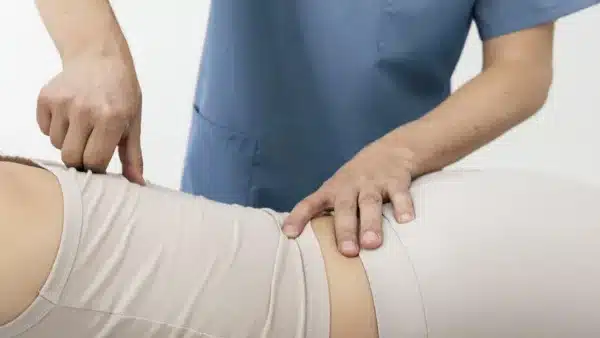
Coccydynia, the medical name for coccyx pain, can feel sharp, dull or aching. It is often worst in a partly reclined position, and standing up from a chair can bring a brief but severe increase in pain. Long sitting and cycling usually make it worse. Some people also feel it when standing for a long time, during bowel movements or during intercourse (Bain et al., 2025).
When pressure irritates the small nerves around the tailbone, some people feel burning, tingling or numbness there. Pain that started after a fall tends to be clearly linked to that day, while pain with no injury often builds slowly.
What Can Be Mistaken for Coccyx Pain
Pain near the tailbone does not always start in the tailbone. It can come from the lower back, including a slipped disc, from the sacroiliac joints where the spine meets the pelvis, or from the pelvic floor muscles. Problems of the lower bowel, bladder or reproductive organs can also send pain to the tailbone. Infection and, rarely, a tumor are among the causes a doctor rules out (Bain et al., 2025).
The Tailbone: Where It Is and What It Does
The coccyx, or tailbone, is the last part of the spine, just below the sacrum. It is made of three to five small bones joined to the bottom of the sacrum by fibrous tissue, so it can move slightly. At birth it is mostly cartilage, and it turns to bone gradually through childhood and the teenage years.
Several muscles of the pelvic floor and buttock attach to it, including part of the gluteus maximus and the levator ani. It also helps hold the anal sphincter in place. When a person sits, the tailbone forms a tripod with the two sitting bones and bends forward slightly to share the load. Some people use the word tailbone for the sacrum as well, but the coccyx is the true tailbone.
Can a Tailbone Be Adjusted? Internal and External Methods
Yes, a tailbone can be adjusted in two ways. External methods work through the skin over the tailbone, sacrum and pelvis. Internal adjustment is done with a gloved finger in the rectum, moving the tailbone from the inside.
CSC uses external methods only: chiropractic manipulation that is non-rotatory using the Activator instrument, on the tailbone, sacrum and pelvis, combined with physiotherapy. Internal coccyx adjustment is intrusive, and CSC does not provide it.
Manual methods suit some tailbones better than others. People whose tailbone moves within the normal range respond better to manual treatment than people whose tailbone barely moves (Bain et al., 2025). Pressing on or trying to pop a painful tailbone at home risks making an injury worse before it has been examined, such as a fracture. The home measures that suit most people are set out under sitting and sleeping below.
Tailbone Sticking Out, Popping or Out of Place: What It Can Mean
A tailbone that seems to stick out, pop or click when sitting down is a common worry. X-rays taken sitting and standing, then compared, show how much it moves. Normal movement is between 5 and 20 degrees; less than 5 degrees is too little, and 20 degrees or more is too much (Bain et al., 2025).
A well-known French study used these X-rays in 208 people with tailbone pain. It found clear patterns: a tailbone that moves too much, one that slips backward when sitting, and small bony spurs at the tip. Heavier people more often had a tailbone that slipped backward, while thinner people more often had a spur (Maigne et al., 2000).
So a tailbone that feels misaligned or out of place may be a normal shape, a spur or a joint that moves too much. The sitting and standing X-rays, read together with a careful examination, are how to know which.
Broken or Bruised Tailbone: Signs, Healing Time and Long-Term Effects
Falling onto the bottom, slipping on stairs or landing hard on a seat can injure the tailbone. The injury can be a bruise, a sprain of the joint between the sacrum and the tailbone, a dislocation or a break. All of these hurt when sitting, and often most when standing up. A fall or a hard landing is the usual cause of a broken tailbone; childbirth is another, covered in the pregnancy section.
How to Tell if the Tailbone Is Broken
The pain of a bruise and a break can feel much the same, so an X-ray is the way to tell them apart. A plain X-ray shows a fracture or a clear dislocation, and sitting and standing X-rays show a joint that has become loose after the fall. A hard fall with severe pain is worth an X-ray.
How Long a Bruised or Broken Tailbone Takes to Heal
Many people feel better within weeks or months of the pain starting, whether or not they receive treatment (Bain et al., 2025). In the first days after a fall, cold packs are used rather than heat, because Yama Zafer, D.C., avoids hot packs on an inflamed area. A cushion, leaning slightly forward when sitting and soft bowel movements take pressure off the tailbone while it settles.
Long-Term Effects of a Broken Tailbone
Most people recover without surgery, but some are left with pain that lasts for months or years (Bain et al., 2025). In the French study of 208 people, a fall in the month before the pain began made a loose, unstable tailbone more likely (Maigne et al., 2000). A tailbone that stays painful after a fracture is examined with sitting and standing X-rays, so that care matches what the joint is doing.
What Causes Coccyx Pain
Coccyx pain usually comes from the tailbone joints and the tissues around them. A fall, childbirth and long hours of sitting, especially slumped back on the tailbone, are the common causes. In some people no clear cause is found (Bain et al., 2025).
It is about five times more common in women than in men (Bain et al., 2025). It is also more common with higher body weight, which changes how a person sits and how much load the tailbone carries. Activities that load the tailbone over and over, such as long cycling, can add to it. A tailbone shaped differently from birth can also make pain more likely.
For a child or teenager with tailbone pain after a fall, see the guide to chiropractic care for children. It explains how a young person is assessed, including bedwetting that starts after a fall onto the tailbone.
Can a Slipped Disc Cause Tailbone Pain?
Yes. A slipped disc at L4-L5 or L5-S1 can irritate a nerve root, and the muscles around the tailbone can tighten in response. A large disc herniation at L5-S1, such as an extruded or fragmented disc, can press on the S1 and S2 nerve roots below it. Pain from these nerves can be felt near the tailbone.
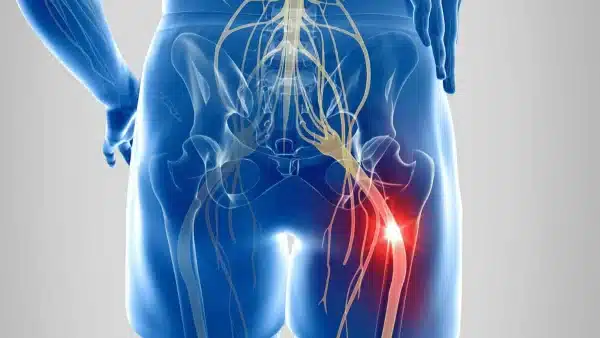
Yama Zafer, D.C., describes sciatica as a nerve problem rather than a muscle problem. The sciatic nerve is formed from the L4, L5, S1 and S2 nerve roots, and in every case he has seen, there is some disc involvement. So people with tailbone pain have the whole spine examined. When the pain comes from the lower back, care is aimed at the lower back as well. Readers whose symptoms travel into the leg can read more about leg pain and nerve-related signs and pinched nerve causes.
Tailbone Pain During Pregnancy and After Childbirth
Tailbone pain is a common complaint during pregnancy and after childbirth. As the baby grows, the center of gravity moves forward and posture changes. The hormones relaxin and progesterone soften the ligaments so the pelvis can widen for delivery. The sacrum and coccyx also tilt forward and back through pregnancy, delivery and the months after, which adds load to the tailbone. Childbirth can also fracture the tailbone, typically by forcing it backward during labor (Bain et al., 2025).
The guides to pregnancy pain and discomfort and back pain in pregnancy describe how care is adapted while expecting. The guide to prenatal and postpartum care covers the months after birth. For the pelvis and hips, see the guides to pelvic pain during pregnancy and hip care in pregnancy.
Gentle, Non-Rotatory Care in Pregnancy
Rotatory spinal manipulation twists the body until a joint pops. That adds twisting load to joints that pregnancy has already loosened. At CSC, chiropractic and physiotherapy are non-rotatory, which matters most for expecting and new mothers.
Care at CSC: Chiropractic and Physiotherapy Combined
Care is planned after the assessment and combines chiropractic and physiotherapy. Yama Zafer, D.C., recommends the two together rather than one or the other; in his words, "Choose both."
- Chiropractic: chiropractic manipulation that is non-rotatory using the Activator instrument, for the tailbone, sacrum and pelvis.
- Physiotherapy: manual therapy for the muscles around the tailbone, hips and lower back, with shockwave therapy or other modalities where they suit the findings.
- Exercise: pelvic floor (Kegel) exercises, which Yama Zafer, D.C., lets his patients start right away, then hip and core exercises once the area is ready.
- Cold packs after a fall: used in the first days, with how long and how often set at the first visit.
- Sitting and sleep: the habits in the next section, practiced every day.
Care is kept within what the patient can comfortably tolerate, and the patient tells the clinician at once if anything hurts. His motto is "No pain, more gain." Progress is checked by repeating the first visit's measures, such as how long sitting is comfortable. If they have not improved by the fifth session, the plan is reviewed, and by the tenth session the next step is decided together.
How to Sit and Sleep With Coccyx Pain
Sitting is where most tailbone pain is felt, so small changes matter:
- A wedge-shaped cushion with a cut-out under the tailbone lets it hover over the gap and carry less weight; U-shaped and donut cushions are other options (Bain et al., 2025).
- Sit with the knees in line with the hips or slightly above them and the feet directly under the knees. Keep the bottom right back against the backrest, as Yama Zafer, D.C., advises. Leaning slightly forward takes load off the tailbone.
- Break up sitting: a break every 15 minutes while back pain is acute, and every 30 to 45 minutes for people without back problems.
- Keep long cycling and hard seats to a minimum while the pain is acute.
- Keep bowel movements soft with fiber and water, since straining can make the pain worse.
Sleep matters as much as sitting. Yama Zafer, D.C., advises at least six hours of sleep. Lie on the right side first, the left side second, or on the back with a bolster under the knees. On the side, a pillow keeps the spine straight and a bolster sits between the knees.
Pelvic Floor and Hip Muscles Around the Tailbone
Several pelvic floor muscles attach to the tailbone, and sitting slumped for long periods strains them. Pelvic floor physical therapy is used when the muscles beside the tailbone are a main source of pain (Bain et al., 2025). At CSC, exercises can continue one-to-one with a physiotherapist at the physiotherapy gym in the Bukit Damansara main center, together with a home program. A gentler program suits people who also have spinal stenosis, sciatica or a slipped disc.