

Ear Ringing in KL: What Causes Tinnitus and When to Get Checked
By Yama Zafer, D.C.
Ear ringing most often starts in the hearing system, though blood flow, the jaw and the neck can also play a part. Tinnitus, the medical term for ringing in the ears, is a sound with no outside source; it can buzz, hiss, whistle, hum, whoosh or throb. In Kuala Lumpur, a family doctor, audiologist or ear, nose and throat (ENT) doctor usually checks hearing first.
Hearing loss from age or years of loud noise is the most common link. Earwax, ear infections, Meniere's disease (an inner ear disorder), some medicines, diabetes and thyroid disorders can also be involved. In some people the sound rises and falls with a jaw or neck problem. In my view, the upper neck can occasionally play a part too.
A few signs need a doctor before neck care. When the jaw or neck changes the sound, the upper neck, jaw and posture are examined. Care can join gentle, non-rotatory chiropractic care with physiotherapy, hands-on muscle work and targeted exercise. In a small trial of 38 people with severe tinnitus and neck complaints, about half reported substantial improvement after neck physiotherapy, though fewer kept it. The upper neck, Meniere's disease, whiplash and daily habits are covered below.
This guide, Ear Ringing (Tinnitus): Causes, Symptoms and the Neck Link, is published by Chiropractic Specialty Center, Bukit Damansara (KL) main center: WhatsApp+60 17 269 1873 Call+603 2093 1000
Ear Ringing: Key Takeaways
| Question | Short answer |
|---|---|
| How is ear ringing usually managed? | For persistent, bothersome tinnitus, a US guideline recommends a hearing aid evaluation where hearing loss is documented, and cognitive behavioral therapy, a talking therapy. Sound therapy, using soft background sound, is an option. Routine drugs and supplements are advised against. |
| Which ear ringing needs emergency care? | Call 999 or go to an emergency department for ringing after a head injury, or with sudden hearing loss, facial muscle weakness or vertigo. Vertigo means a sense of spinning. Do not drive yourself. |
| What if the ringing pulses with my heartbeat? | A sound that beats in time with the pulse needs an urgent doctor's appointment, according to the NHS. Blood vessel causes usually produce this pulsing sound, and they need a medical check before any neck care. |
| When is a prompt hearing test needed? | A US guideline advises one for tinnitus in one ear only, tinnitus lasting six months or more, or tinnitus with hearing difficulty. An audiologist does the test, and an ENT doctor looks for ear disease. |
| Does stress make ear ringing worse? | It can. The NHS names stress and loud background noise among things that make tinnitus worse, and anxiety and depression are linked to it. Sleep and a calmer routine are part of daily care. |
| Can Eagle syndrome or C1 cause tinnitus? | Tinnitus is among the symptoms of Eagle syndrome, where a long bony spike below the ear irritates nearby nerves. In my view, a moderately or severely malpositioned C1, the top neck bone, can mimic it through those nerves. |
| Did neck physiotherapy change tinnitus in research? | Right after six weeks of neck physiotherapy, 53 percent of the trial's 38 people reported substantial improvement. Six weeks later the figure was 24 percent, and the authors called for larger studies. |
| Can the jaw or neck change the sound? | Often. Many people can make their ear ringing louder or shift its pitch by clenching the jaw or moving the head, neck or eyes. Most changes are small, though some are large. |
| Is ear ringing common? | Yes. A 2022 worldwide review put any tinnitus at about 14 percent of adults. A 2013 review adds that many people get used to it, while it seriously affects daily life for 1 to 2 percent of all people. |
Ear Ringing Guide: Sections at a Glance
- Neck and Ear Ringing: What Does the Research Show?
- Neck and Jaw Assessment at Two KL Centers
- Tinnitus Symptoms: What the Sound Can Be Like
- What Causes Ringing in the Ears?
- Somatic Tinnitus: When a Jaw or Neck Problem Changes the Sound
- Upper Neck, Eagle Syndrome and the Styloid
- Warning Signs: When to See a Doctor First
- Chiropractic and Physiotherapy When the Neck or Jaw Is Involved
- Usual Care & Daily Habits: Sleep, Sound and Posture
- Related Guides on Ears, Jaw and the Upper Neck
- Questions Readers Often Ask
Neck and Ear Ringing: What Does the Research Show?
In the studies below, jaw and neck movements changed ear ringing in many people. None of them shows that most ear ringing starts in the neck, and the one trial of neck care was small.
Movements of the eyes, head, neck, jaw and shoulders shifted the loudness or pitch of tinnitus in many patients. The change was usually modest and usually an increase, though some people found it doubled or tripled (Simmons and colleagues, 2008).
In a smaller group the head or upper neck seems to drive the sound. These people share a head or upper neck problem and tinnitus in the ear on the same side. They have no balance complaints, and their hearing tests are usually normal (Levine, 1999). Levine proposed that nerves carrying sensation from the head and neck feed into the dorsal cochlear nucleus, an early hearing relay in the brainstem.
A Belgian trial gave 38 people with severe tinnitus and neck complaints 12 sessions of neck physiotherapy over six weeks. Right after, 53 percent reported substantial improvement, and 24 percent still did six weeks later. The authors asked for larger studies (Michiels and colleagues, 2016).
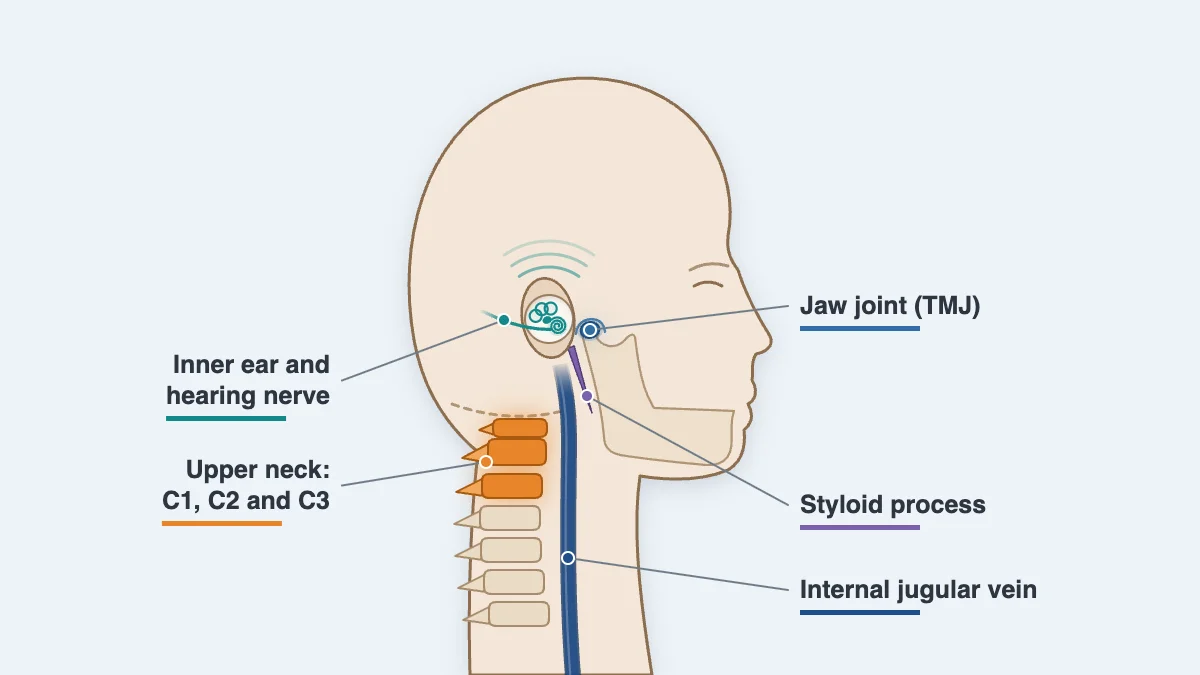
The neck can also matter through the internal jugular vein, the main vein draining blood from the head. A study of 46 people whose jugular veins were narrowed by neck bones found 69 narrowed veins. C1's side projection, its transverse process, pressed on 35 of them alone. With the styloid process, the slim bony point under the ear, it pressed on 31 others (Ding and colleagues, 2020). Across 149 reported patients with this narrowing, 43.6 percent had tinnitus (Scerrati and colleagues, 2021).
In my view, the clinician must look for possible upper neck involvement, which the styloid can complicate and a jaw joint problem may worsen. That is why the neck and jaw are examined whenever ear ringing shifts with movement.
Neck and Jaw Assessment at Two KL Centers
If ringing shifts with jaw or neck movement and hearing has been checked, a first visit examines both; the contact page gives directions and hours.
- Bukit Damansara (KL, main center): Call +603 2093 1000 or WhatsApp +60 17 269 1873 to see the Bukit Damansara / KL center.
- Bandar Sri Damansara (KL): Call +603 6262 5777 or WhatsApp +60 12 455 6939 to see the Bandar Sri Damansara center.
Tinnitus Symptoms: What the Sound Can Be Like
The NHS describes tinnitus as sounding like any of these:
- Ringing.
- Buzzing.
- Whooshing.
- Humming.
- Hissing.
- Throbbing.
- Music or singing.
The sound may be in one ear, both ears or the head, and it may come and go or never stop (NHS, 2024). Some people also notice a feeling of fullness in the ear. Ear ringing is more common with age and with noise exposure, but it can start at any age.
Ear ringing is a symptom rather than a disease. Research suggests that when the inner ear sends less input to the brain, for example after hearing loss, the hearing pathways can become more active. That activity is heard as sound (Langguth and colleagues, 2013). How much it bothers a person also depends on attention, sleep, stress and mood.
About one adult in three notices ear ringing at some point. For 10 to 15 percent of adults, it lasts long enough to need a medical check (Heller, 2003).
Some people with ear ringing also find everyday sounds too loud. Of 100 people with this sound sensitivity in one series, 86 percent also had tinnitus. For many, sounds were painful (Anari and colleagues, 1999).
What Causes Ringing in the Ears?
Most ear ringing is linked to the hearing system, often with some degree of hearing loss. Other causes include earwax, ear infections, Meniere's disease, some medicines, blood vessel problems, head injury, and jaw or neck problems. Even so, it is not always clear what causes it (NHS, 2024).
The NHS says tinnitus is often linked to:
- Some form of hearing loss.
- Meniere's disease.
- Conditions such as diabetes, thyroid disorders or multiple sclerosis.
- Anxiety or depression.
- Certain medicines, including some chemotherapy medicines, antibiotics, anti-inflammatory painkillers (NSAIDs) and aspirin.
Hearing loss that comes with age, and damage from loud noise, are the most common links. Ear conditions matter too: an earwax blockage, a middle ear infection or fluid, otosclerosis (stiffening of the tiny middle ear bones) and Meniere's disease.
Some medicines can start or worsen ear ringing. Do not stop a prescribed medicine without speaking to your doctor. Blood vessel causes usually make a pulsing sound in time with the heartbeat, and they need a medical check.
A review lists hearing loss, medicines that can harm the ear, head injury and depression among the risk factors (Baguley and colleagues, 2013). Jaw joint (TMJ) disorders and neck pain matter mainly when the ringing changes with movement.
Stress, poor sleep and anxiety do not usually start ear ringing, but they can make it more noticeable and harder to live with.
Somatic Tinnitus: When a Jaw or Neck Problem Changes the Sound
Somatic tinnitus is ear ringing that a head, neck or jaw problem appears to drive. The sound can change in loudness or pitch with movement of, or pressure on, the head, neck, jaw or eyes.
Signs that point toward a somatic part include:
- Ringing that changes when the jaw clenches or the neck moves.
- Ringing that began or worsened with a neck or jaw problem.
- Ringing that rises and falls along with neck pain or jaw pain.
- Ringing on the same side as the neck or jaw problem, with hearing tests that are usually normal (Levine, 1999).
In my view, the upper neck and the jaw affect each other both ways. A chronic problem high in the neck can lead to jaw trouble, and a jaw problem can, in turn, disturb the upper neck.
Upper Neck, Eagle Syndrome and the Styloid
The styloid process is a thin spike of the skull just below the ear. The internal jugular vein and lower cranial nerves pass between it and the side of C1, the top neck bone (Ozveren and colleagues, 2003).
In Eagle syndrome, a long styloid process or a hardened ligament beside it irritates nearby structures. Tinnitus is among the symptoms described (Dua and Mohseni, 2026).
In my view, a moderately or severely malpositioned C1 can mimic the symptoms of Eagle syndrome, because the same cranial nerves run there. Of those nerves, the hearing and balance nerve is less often involved, though irritation or blood vessel changes nearby can occasionally add tinnitus or dizziness. Some people have a styloid that is slightly long yet within normal length, and it usually causes no trouble. With an upper neck malalignment beside it, Eagle-like symptoms of varying degree become possible and probable.
As I put it, "None of these things are a standalone. When one goes, the other goes, much like a kinematic chain." For the top three neck levels in detail, see the upper cervical guide.
Meniere's Disease, Vertigo and Venous Drainage
Meniere's disease is an inner ear condition whose symptoms start suddenly and last from a few minutes to 24 hours. The NHS lists these symptoms:
- Spinning vertigo.
- Loss of balance.
- Ringing or buzzing in one or both ears.
- Hearing loss.
- Pressure, discomfort or pain deep inside the ear.
- Nausea or vomiting.
Over time, hearing may gradually worsen and the tinnitus may become constant (NHS, 2026).
One study imaged the veins draining the brain and spinal cord in 24 people with Meniere's disease and 28 with other inner ear disorders. Abnormalities showed in 83 percent and 57 percent respectively (Di Berardino and colleagues, 2015). The authors suggested that poor venous drainage might set the stage for the inner ear fluid build-up seen in the disease.
In my view, the upper neck and the styloid offer a plausible but unconfirmed path to tinnitus and, less often, to Meniere's features. Controlled studies are still needed to show how strong these links are. I also see headaches, migraines, dizziness and vertigo as related to the upper cervical segments.
Whiplash and Head Injury
Head injury is a recognized risk factor for tinnitus (Baguley and colleagues, 2013). Levine gave whiplash and jaw joint problems as examples of body disorders related to tinnitus (Levine, 1999). A 1962 paper was titled "Meniere-like syndrome following whiplash injury of the neck" (Braaf and Rosner, 1962). Emergency care comes first for ringing after a head injury, or with sudden hearing loss, facial muscle weakness or vertigo. The whiplash guide covers the neck after a car accident.
Warning Signs: When to See a Doctor First
Most ear ringing is checked by a family doctor, an audiologist or an ENT doctor. A few signs need faster care.
The NHS advises going to an emergency department or calling 999 for tinnitus with any of these:
- Tinnitus after a head injury.
- Tinnitus with sudden hearing loss, weakness in the muscles of the face, or a spinning sensation (vertigo).
Do not drive yourself. Someone else can drive you, or call 999 for an ambulance. Bring any medicines you take.
The NHS advises an urgent doctor's appointment for tinnitus that beats in time with the pulse. It advises seeing a doctor for tinnitus with any of these:
- Tinnitus that is there regularly or all the time.
- Tinnitus that is getting worse.
- Tinnitus that bothers you, for example by affecting sleep or concentration, or making you feel anxious and depressed.
A US guideline adds a prompt, full hearing test for tinnitus (Tunkel and colleagues, 2014):
- In one ear only.
- Lasting six months or more.
- With hearing difficulty.
For spinning vertigo, the NHS gives a stroke list. Call 999 for vertigo with any of these:
- The face drooping on one side.
- Being unable to lift both arms and keep them there.
- Difficulty speaking; speech may be slurred or garbled.
- Sudden problems with the vision in one eye.
- Feeling very off-balance.
These can be signs of a stroke, a medical emergency (NHS, 2026). Do not drive yourself to an emergency department.
Neck or jaw care waits until a doctor has checked any of these signs.
Chiropractic and Physiotherapy When the Neck or Jaw Is Involved
Chiropractic and physiotherapy at CSC look after the neck and jaw side of ear ringing:
- Suited to: ringing that shifts with neck or jaw movement or pressure, beside a hearing test and medical care, never in place of them.
- Not expected to change: ear ringing that comes from the ear itself.
The first visit starts with a long interview and the results of any hearing test. Bring the scans themselves, not only the reports. The examination covers the upper neck from the skull to C3, the jaw joints and muscles, and posture.
My video Is Chiropractic Safe? 13 Questions Answered gives my view in my own words: "I have always recommended chiropractic plus physiotherapy combined ... Don't choose between one or the other. Choose both." A plan for neck-linked ear ringing may draw on:
- Chiropractic manipulation that is non-rotatory using the Activator instrument; forceful, high-speed twisting of the neck is avoided.
- At the atlas (C1), I use a non-force contact with the lightest pressure on the side of the bone. When the neck is stable, I may add the Activator, set to level one and cushioned, on the soft tissue next to the atlas.
- Jaw muscle work and jaw exercises when the jaw is involved.
- Physiotherapy and hands-on soft tissue work for the neck and upper back, with neck mobility and strengthening exercises.
- Changes to sleep, posture and screen habits.
At CSC, the neck is never pulled, cracked or yanked with force. In Neck Cracks Are Dangerous, I describe the small joints of the neck and the artery that runs right beside them. To me the danger is many-sided: a small stroke risk, and an existing neck problem made worse.
Care is kept within what you can comfortably tolerate. Discomfort means care has become too aggressive, so tell the chiropractor straight away, as I ask in Is Chiropractic Safe? 13 Questions Answered. There I also share the motto I have always kept: "No pain, more gain." Possible effects and risks are explained before care begins.
By conservative care I mean focused care, planned from the examination and any scans and aimed at the causes they show. It takes in the neck and jaw together and does no harm. Run-of-the-mill neck treatment does not qualify, and many forms of conservative care are useless.
None of the studies cited here tested chiropractic care for ear ringing, so care is planned around the neck and jaw findings. Progress is judged against the first visit's findings.
The guide to tinnitus treatment in Malaysia compares the care options in more depth.
Every fee, from the first examination to follow-up visits, is on the chiropractic price in Kuala Lumpur and physiotherapy price list in Kuala Lumpur pages. The fee for a plan is explained and agreed before care begins.
Usual Care & Daily Habits: Sleep, Sound and Posture
For persistent, bothersome tinnitus, the US guideline recommends cognitive behavioral therapy, and a hearing aid evaluation where hearing loss is documented. Sound therapy is an option. It advises against routine antidepressants, anticonvulsants, anxiety medicines and supplements such as ginkgo, melatonin or zinc (Tunkel and colleagues, 2014).
In the UK, the NHS may refer people for cognitive behavioral therapy, tinnitus counseling or tinnitus retraining therapy. Digital CBT, delivered online or through an app, usually comes first.
The NHS suggests these steps for coping day to day:
- Try to relax, for example with deep breathing.
- Improve sleep, for example with a bedtime routine and less caffeine.
- Avoid what makes tinnitus worse, such as stress or loud background noise.
- Avoid total silence; soft music or sounds can draw attention away.
- Try not to focus on it; hobbies and activities can take the mind off it.
- Join a support group.
In my Back Pain to Leg Pain talk, I name the two things to be most mindful of: sleep first, then posture. In the talk I ask for at least seven to eight unbroken hours of sleep; in Neck and Back Self-Help Tips, at least six.
In Desk Posture Mistakes, I recommend standing up every 15 minutes when you have neck or back issues, and walking for 10 to 20 seconds. Without a back problem, I advise a break every 30 to 45 minutes.
My Neck Trigger Points and Exercises video shows gentle home care for the neck and upper back. In it, I ask you to show anything I demonstrate to your doctor before you try it.
Many people stop noticing the sound over time as the brain learns to tune it out (Langguth and colleagues, 2013; Rauschecker and colleagues, 2010).
Related Guides on Ears, Jaw and the Upper Neck
These guides cover the ear, jaw and neck problems that often come up alongside ear ringing.
If you would like to keep reading, my neck trigger point video, my video on neck cracking, and Eagle syndrome are closely related topics.
Ear, Head and Upper Neck
- Tinnitus Treatment in KL: Care Options From Ear to Neck
- Headache and Migraine in KL: Causes & the Upper Neck's Role
- Eagle Syndrome: Structured Non-Invasive Care Options
- Whiplash Neck Injury Care in Kuala Lumpur
- Upper Cervical Chiropractor: C0-C3 Chiropractic in KL
- Occiput and Atlas (C0-C1): What This Joint Does
- C1-C2 (Atlas & Axis): Symptoms, Nerves and Adjustment
- C2-C3 Segment Dysfunction: Spine, Nerves and Neck Pain
Jaw and TMJ
- TMJ Treatment in Malaysia: How Options Are Decided
- Jaw Pain and TMD: What the Symptoms Can Mean
- TMJ Disorders: Jaw Clicking, Stiffness and Assessment
- Jaw and TMD in Malaysia: Non-Invasive Care Options
- Slipped Disc in the Jaw: TMJ Displacement, Causes & Care Options
- Jaw Chiropractor in KL: TMJ Care Guide
- Temporomandibular Joint Dysfunction Care By Jaw Experts
- Causes of TMJ Pain: Jaw Concerns You Should Know
Neck Care in Kuala Lumpur
- Neck and Upper Back Care in Kuala Lumpur
- Neck Pain Assessment in Kuala Lumpur: What It Covers
- Neck Chiropractor KL: Assessment and Low-Force Care
- Neck Stiffness Care in Kuala Lumpur
- Cervical Spondylosis: Non-Invasive Care in KL
- Text Neck: What Causes It and How It Is Assessed
- Neck Exercises for Neck Pain and Stiffness
- Is the Ring Dinger® Safe? Side Effects and What It Does
- Neck Trigger Points and Exercises: Video Guide
- Neck Cracks Are Dangerous Explained (Video)
Questions Readers Often Ask
Should I see a chiropractor for tinnitus?
Start with a hearing test, because most ear ringing begins in the hearing system. If the ringing shifts when you clench your jaw or move your neck, an examination of the upper neck and jaw makes sense. None of the studies cited here tested chiropractic care for ear ringing, and the one trial of neck physiotherapy was small. In Is Chiropractic Safe? 13 Questions Answered, I explain why I recommend chiropractic and physiotherapy together. Any sign in the warning list goes to a doctor first.
Can physiotherapy change tinnitus?
In one trial, it did for some people with severe tinnitus and neck complaints. Of 38 people in Belgium, half began neck physiotherapy at once and half six weeks later. Tinnitus and neck scores both fell after treatment (Michiels and colleagues, 2016). The trial was small, and its authors asked for larger studies. At CSC, physiotherapy for neck-linked ear ringing works on the neck, upper back and jaw muscles, alongside chiropractic care.
Can neck problems cause ringing in the ears?
They can play a part in some people. A 1999 paper proposed that nerves carrying sensation from the head and neck feed an early hearing relay in the brainstem (Levine, 1999). That may explain why neck movement can change the sound. C1 can also narrow the jugular vein in some people (Ding and colleagues, 2020). Most ear ringing, though, is linked to the hearing system, so a hearing check comes first.
Can TMJ cause ear ringing?
They can be linked. In a 1999 case series, jaw joint problems were one of the examples of body disorders tied to tinnitus (Levine, 1999). The jaw joint lies right in front of the ear canal, and jaw movements shifted tinnitus in many patients (Simmons and colleagues, 2008). In my view, the upper neck and the jaw affect each other both ways, so both are examined. The jaw pain guide explains the common jaw symptoms.
Is ear ringing serious?
Usually not. The NHS says tinnitus is not usually a sign of anything serious and may get better by itself. Call 999 or go to an emergency department for tinnitus after a head injury, or with sudden hearing loss, facial muscle weakness or vertigo. A pulsing sound in time with the heartbeat needs an urgent doctor's appointment. Ringing that comes regularly or constantly, gets worse, or affects sleep, concentration or mood also deserves a doctor's review (NHS, 2024).
Which doctor or specialist should I see first?
Start with a family doctor, who can look for earwax or an ear infection and check for hearing loss. An audiologist measures hearing in detail, and an ear, nose and throat (ENT) specialist looks for ear disease. A prompt hearing test matters when ringing is in one ear, has lasted six months or comes with hearing difficulty (Tunkel and colleagues, 2014). A neck and jaw examination comes after that, when movement changes the sound.
Can whiplash cause tinnitus?
It can be linked. Levine named whiplash among the body disorders related to tinnitus (Levine, 1999), and head injury is a known risk factor (Baguley and colleagues, 2013). Ringing after a head injury, or with sudden hearing loss, facial muscle weakness or vertigo, needs an emergency check first. Once that is clear, the top of the neck can be examined for strain. The whiplash guide explains that assessment.
Does tinnitus go away?
It depends on the cause. Ringing from earwax or an ear infection can stop once that is treated. Long-standing ear ringing often fades into the background as the brain gets used to it (Langguth and colleagues, 2013). Hearing aids for hearing loss, sound therapy and cognitive behavioral therapy are the main supports (Tunkel and colleagues, 2014). When the neck or jaw changes the sound, those areas are examined as well.
Can stress or poor sleep make the sound worse?
Yes. Neither usually starts ear ringing, but both can make the sound stand out more and weigh on daily life. A steady bedtime routine, less caffeine and quiet background sound at night are simple first steps. The NHS links tinnitus with anxiety and depression, so ringing that brings low mood or anxiety deserves a doctor's review.
How to Read This Guide
My own views are written in the first person. When a view comes from a video or talk of mine, I name it. Studies appear by first author and year, each linked in the list below. Studies describe groups, so they cannot say what one person's ear ringing will do. This guide cannot diagnose the cause of anyone's tinnitus, which takes a hearing test and an examination. Your own doctor's advice comes first.
References and Sources
- Anari M, Axelsson A, Eliasson A, Magnusson L. Hypersensitivity to sound: questionnaire data, audiometry and classification. Scand Audiol. 1999;28(4):219-230.
- Baguley D, McFerran D, Hall D. Tinnitus. Lancet. 2013;382(9904):1600-1607.
- Braaf MM, Rosner S. Meniere-like syndrome following whiplash injury of the neck. J Trauma. 1962;2:494-501.
- Di Berardino F, Alpini DC, Bavera PM, et al. Chronic cerebrospinal venous insufficiency in Meniere disease. Phlebology. 2015;30(4):274-279.
- Ding JY, Zhou D, Pan LQ, et al. Cervical spondylotic internal jugular venous compression syndrome. CNS Neurosci Ther. 2020;26(1):47-54.
- Dua A, Mohseni M. Eagle syndrome. StatPearls. Treasure Island (FL): StatPearls Publishing; 2026.
- Heller AJ. Classification and epidemiology of tinnitus. Otolaryngol Clin North Am. 2003;36(2):239-248.
- Jarach CM, Lugo A, Scala M, et al. Global prevalence and incidence of tinnitus: a systematic review and meta-analysis. JAMA Neurol. 2022;79(9):888-900.
- Langguth B, Kreuzer PM, Kleinjung T, De Ridder D. Tinnitus: causes and clinical management. Lancet Neurol. 2013;12(9):920-930.
- Levine RA. Somatic (craniocervical) tinnitus and the dorsal cochlear nucleus hypothesis. Am J Otolaryngol. 1999;20(6):351-362.
- Michiels S, Van de Heyning P, Truijen S, Hallemans A, De Hertogh W. Does multi-modal cervical physical therapy improve tinnitus in patients with cervicogenic somatic tinnitus? Man Ther. 2016;26:125-131.
- National Health Service (NHS). Tinnitus. NHS website; page last reviewed 12 January 2024.
- National Health Service (NHS). Meniere's disease. NHS website; page last reviewed 11 September 2026.
- Ozveren MF, Türe U, Ozek MM, Pamir MN. Anatomic landmarks of the glossopharyngeal nerve: a microsurgical anatomic study. Neurosurgery. 2003;52(6):1400-1410.
- Rauschecker JP, Leaver AM, Mühlau M. Tuning out the noise: limbic-auditory interactions in tinnitus. Neuron. 2010;66(6):819-826.
- Scerrati A, Norri N, Mongardi L, et al. Styloidogenic-cervical spondylotic internal jugular venous compression, a vascular disease related to several clinical neurological manifestations: diagnosis and treatment, a comprehensive literature review. Ann Transl Med. 2021;9(8):718.
- Simmons R, Dambra C, Lobarinas E, Stocking C, Salvi R. Head, neck, and eye movements that modulate tinnitus. Semin Hear. 2008;29(4):361-370.
- Tunkel DE, Bauer CA, Sun GH, et al. Clinical practice guideline: tinnitus. Otolaryngol Head Neck Surg. 2014;151(2 Suppl):S1-S40.
These sources describe tinnitus, its causes and its links with the jaw, neck and veins in general. None of them evaluates care at Chiropractic Specialty Center.
The Author of Ear Ringing (Tinnitus): Causes, Symptoms and the Neck Link
Ear Ringing (Tinnitus): Causes, Symptoms and the Neck Link was written by Yama Zafer, D.C., who has 30+ years in chiropractic and physiotherapy and founded Chiropractic Specialty Center in Kuala Lumpur in 2006.
Last Updated: Ear Ringing in KL: What Causes Tinnitus and When to Get Checked
Ear Ringing in KL: What Causes Tinnitus and When to Get Checked was last reviewed and updated on October 13, 2026.