
What Is a Prolapsed Disc in the Spine? Symptoms, Causes and Care
By Yama Zafer, D.C.
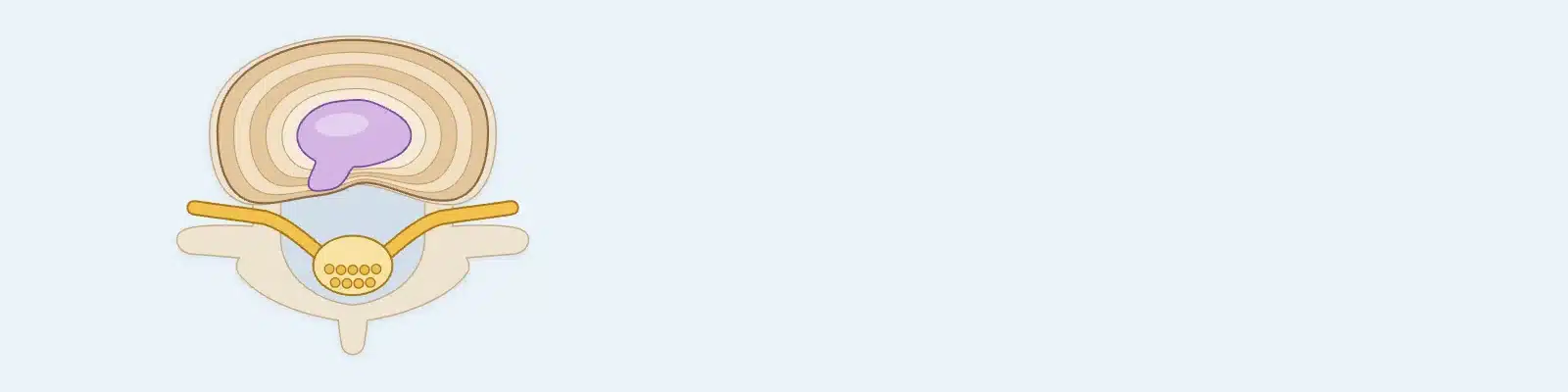
A prolapsed disc is a slipped disc that is barely contained. In a disc prolapse, a few remaining outer fibers still keep the soft center from rupturing into the spinal canal. This stage follows a protrusion and comes before a herniation. Unlike a true bulge, it can reach a nerve root or push aside the sac that holds the nerves. Pain, numbness, tingling or weakness can then spread to a leg or an arm.
No disc prolapses unless degeneration came first, which my Back Pain to Leg Pain talk sets out. Daily load, from long sitting to bending, twisting and lifting, weakens the outer fibers, and the center then pushes toward the weakest point.
When a scan comes with the patient, I almost always read its images first, then examine, and plan care from both. That care can combine physiotherapy and chiropractic manipulation that is non-rotatory using the Activator instrument, with exercise once the spine is stable. A spine with a damaged disc is never twisted or cracked, and care is kept within what you can comfortably tolerate. What follows covers the stages, symptoms, MRI wording, care and surgery.
This guide, Prolapsed Disc Meaning: Barely Contained, Not Yet Ruptured, is published by Chiropractic Specialty Center, Bukit Damansara (KL) main center: WhatsApp+60 17 269 1873 Call+603 2093 1000
Prolapsed Disc: Key Takeaways
| Question | Short answer |
|---|---|
| Is a prolapsed spine the same as a prolapsed disc? | Yes. People say prolapsed spine, but the spine itself never prolapses; a disc between two vertebrae does. My Back Pain to Leg Pain talk names L4-L5 as the level where disc problems are most common, then L5-S1. |
| Is a prolapsed disc the same as a slipped disc? | Every prolapse is a slipped disc, but not every slipped disc is a prolapse. People say slip disc for any stage, from a bulge to fragmentation. As my Back Pain to Leg Pain talk admits, discs don't actually slip. |
| Prolapsed or bulging disc: which is more serious? | A prolapse. On my 0-to-10 seriousness scale, a true bulge rates 1 or 2 and touches no nerve. A disc pressing a nerve, or pushing aside the sac holding the nerves, rates 3 to 5. |
| What is the most common cause of a prolapsed disc? | Axial load bearing, the downward press of body weight on each disc, tops the causes in my Back Pain to Leg Pain talk. In the same talk, posture and sleep are the two habits people neglect most. |
| Does a prolapsed disc show on an MRI? | Yes. An MRI shows the disc itself, though the report's word may not match my stages. My Back Pain to Leg Pain talk explains why reports seldom tell a bulge, a prolapse and a herniation apart. |
| When can exercise start with a prolapsed disc? | Exercise starts once the spine is stable, usually from the fifth to the seventh session, for some people the third. Before that, I prescribe no stretching or exercise apart from Kegel exercises. The first program is gentle and suits the person's condition and age. |
| Which signs are urgent? | New numbness around the genitals or anus, new difficulty passing urine, or loss of bladder or bowel control needs urgent medical attention at a hospital emergency department straight away, within hours. |
Prolapsed Disc Guide: Sections at a Glance
- Video: What Does a Prolapsed Disc Look Like Inside the Spine?
- Arranging an Assessment for a Prolapsed Disc
- Where a Disc Prolapse Sits Among the Stages
- What Causes a Disc Prolapse?
- Everyday Movement With a Barely Contained Disc
- How Sitting Habits Can Influence Spinal Disc Changes
- Prolapsed Disc Symptoms in the Back, Legs, Neck and Arms
- Why Location Matters More Than Size
- Urgent Signs and When to Act
- What Prolapse Means on an MRI Report
- How Care Is Structured for a Prolapsed Disc
- Where Surgery Fits With a Disc Prolapse
- Recap: What You Need to Know
- Related Pages on Disc Stages and Care
- Common Questions About a Prolapse
- How to Read This Guide
- Peer-Reviewed Medical Reference
Video: What Does a Prolapsed Disc Look Like Inside the Spine?
Inside the spine, a prolapsed disc has its soft center pressed toward the back, against the last few outer fibers still holding it. My Short Prolapsed Disc: A Simple Explanation shows this in 15 seconds and places a prolapse among the stages of disc damage.
Key Moments
- 0:00 What a prolapsed disc means
- 0:05 How the disc is still barely contained
- 0:10 What keeps the center out of the spinal canal
What I say in the Short
“A disc prolapse is the progression of a protruded disc. It is a slipped disc that is barely contained. A prolapsed disc is a slipped disc where a few of the remaining outer disc structures keep the center of the disc, the nucleus pulposus, from rupturing into the spinal canal.”
Arranging an Assessment for a Prolapsed Disc
To arrange an assessment for a prolapsed disc, see the Bukit Damansara contact page and the Bandar Sri Damansara contact page, or call either center directly:
- Bukit Damansara (KL, main center): Call +603 2093 1000 or WhatsApp +60 17 269 1873 to see the Bukit Damansara / KL center.
- Bandar Sri Damansara (KL): Call +603 6262 5777 or WhatsApp +60 12 455 6939 to see the Bandar Sri Damansara center.
For a prolapse, the first visit tests the nerves the disc may reach: reflexes, skin sensation and muscle strength. Movement is checked too, along with orthopedic tests, set maneuvers that load particular structures. Most people arrive without a scan, so the examination comes first; an MRI follows only if it points to a disc or joint problem. If you have one, bring the scan images themselves on CD or film, since they show more than the report. For opening hours, addresses and directions, see the CSC locations page.
Where a Disc Prolapse Sits Among the Stages
A disc prolapse sits between a protrusion and a herniation, and my Shorts treat each stage as a progression of the one before. In a protrusion, the center has begun to migrate outward, but the outer fibers still contain it. In a prolapse, the center has pushed further out, and only a few remaining outer fibers keep it in. In a herniation, those last fibers tear, and the center comes up against what lies in the spinal canal or a nerve opening.

My Back Pain to Leg Pain talk calls protrusion and prolapse interchangeable, “depending on who you ask”. My Shorts put the protrusion first, and this guide follows them. In the same talk, I describe a prolapse as damage in the outer ring while the center “has not broken through these fibers”.
The stages section of the herniated disc guide lists every stage, from the damaged disc to fragmentation.
What Causes a Disc Prolapse?
A disc prolapse is caused by load acting, usually over years, on a disc that degeneration has already weakened. My Back Pain to Leg Pain talk is plain about it: no bulge, protrusion, prolapse or herniation forms without degeneration. The same talk names axial load bearing as the most common cause of that damage. It means the upper body's weight pressing down through each disc, all day long.
Spinal discs are designed to handle pressure, movement and load throughout daily activity, but they rely on balance. Over time, repeated stress changes how a disc spreads pressure:
- Long periods of sitting.
- Repeated bending or lifting.
- Uneven posture.
- Too little variety in movement.
Age is one factor among several, in my view. Genetics, daily habits, earlier injuries and posture all play a part, and the damage can begin far earlier than most people believe.
As the pressure builds, the outer fibers weaken. If the load goes on, a protrusion can progress to a prolapse, and a prolapse to a herniation, an extrusion and fragmentation. My Back Pain to Leg Pain talk is clear about the pace: “Once you have a damaged disc, it can go rapidly or it can take years.” Each of these loads is explained in What Are the Causes of a Herniated Disc?
Everyday Movement With a Barely Contained Disc
A disc prolapse changes how the body moves, steadies itself and carries load through the day. Everyday activities can feel different:
- Sitting loads the lower back discs, and leaning forward in the chair loads them more.
- Bending forward shifts more of the load onto the disc.
- Standing for long spells can tire the muscles around the spine. In Neck and Back Self-Help Tips, I advise standing tall, belly button drawn toward the spine, weight even on both feet and knees unlocked.
- Turning or reaching can feel restricted or uneven.
When one level no longer handles pressure evenly, the body compensates. The muscles beside the spine tighten to guard it, and movement patterns shift. That is why symptoms can come and go, and why they do not always follow the size of the prolapse.
Moving often matters for the same reason. In Sciatica vs Slipped Disc, I explain that in long, still sitting, pressure “builds and builds and builds”. Walking, by contrast, mobilizes the joints and “depressurizes them”.
Yoga is ruled out with a disc prolapse. My Back Pain to Leg Pain talk is direct: “If you have this problem, do not do yoga at all, even if it feels good.” Its deep folds and twists load the very level that is coping least.
How Sitting Habits Can Influence Spinal Disc Changes
Sitting habits decide how much pressure a prolapsed disc carries through a working day. In my Desk Posture Mistakes video, I set up a chair, desk, keyboard and screens step by step. There, I ask anyone with neck or back issues to get up every 15 minutes, and my own phone timer goes off every 30 minutes. With back pain, my rule is a short walk every 15 to 20 minutes; without a back problem, a break every 30 to 40 minutes.
Key Moments
- 00:00 Why sitting posture matters
- 00:36 Armrest and chair positioning
- 01:21 How posture affects spine loading
- 01:46 Step-by-step sitting setup
- 02:57 Keyboard and wrist positioning
- 04:36 Monitor and screen height
- 05:02 Why long sitting adds stress
- 07:46 Final posture guidance
“You don't have to do much. Just stand up, walk for 10 to 20 seconds, move around.” (Desk Posture Mistakes, 5:28)
Prolapsed Disc Symptoms in the Back, Legs, Neck and Arms
Prolapsed disc symptoms depend on what the disc presses on and how irritated that tissue becomes. Some prolapses cause no symptoms at all. When a nerve root, or the sac holding the nerves, becomes irritated, symptoms follow that nerve, away from the spine. Nerve symptoms include radiating pain, tingling or altered feeling, and weakness in particular muscles.
From the lower back, a prolapse can bring:
- Lower back pain, often worse with prolonged sitting.
- Pain into the buttock and down the thigh, sometimes into the calf or foot, as in sciatica.
- Tingling or altered feeling in the leg.
- A weaker leg, such as a foot that catches.
From the neck and upper back, it can bring:
- Neck stiffness or pain.
- Pain toward the shoulder or down the arm.
- Tingling or altered feeling in the hand.
- A weaker grip or arm.
- Pain or a burning feeling between the shoulder blades.
- Pain toward the chest, which a medical doctor always checks first, since the heart can cause it.
In Poor Posture Damages Your Spine, I warn that pinched nerves raise the pain and bring on weakness, and walking any distance gets hard. I also say there that no back pain is normal, and even pain that comes and goes needs attention.
Why Location Matters More Than Size
Where a disc prolapses matters more than how big it looks. How serious one is, in my view, depends on the tissue it reaches. A report names the direction:
- Central: toward the middle of the spinal canal, where the sac around the nerves lies.
- Subarticular: just to one side, along the path of the nerve root crossing that disc. At L4-L5, for example, that is the L5 root. I judge it by the pain's path along its nerve and skin area, and by the MRI showing it touched or compressed.
- Foraminal: inside the foramen, the side opening a nerve root passes through as it leaves the spine.
- Extraforaminal: outside that opening, farther to the side.
A small prolapse beside a nerve root may cause clear symptoms, while a larger one elsewhere may cause few or none. On my 0-to-10 seriousness scale, a disc that pushes aside the sac, fills the foramen or touches a nerve rates 3 to 5. By my definition, such a disc is no longer a simple bulge, whatever the report calls it.
What else sits at that level matters too. A prolapse seldom comes alone, in my experience. Enlarged facet joints, a thickened ligamentum flavum, bone spurs or a slipped vertebra often share its level. Each narrows the room the nerve has, so the same prolapse can matter more beside them.
Facet joints are the small joints paired at the back of the spine, one pair at each level. The ligamentum flavum is a normally elastic band inside the canal, behind the nerves. The guides to facet hypertrophy and ligamentum flavum hypertrophy explain both changes.

Urgent Signs and When to Act
If you have back or leg pain associated with a prolapsed lumbar disc, get urgent medical attention, a thorough assessment at a hospital emergency department straight away, within hours, if numbness develops or worsens around your genitals, between your genitals and anus, or around your anus. New difficulty passing urine needs the same urgent assessment; loss of bladder or bowel control does not have to occur first, and if it does occur, it is urgent too. These symptoms have several possible causes. Some may call for an invasive procedure, but the assessment determines what care is appropriate, rather than assuming surgery is necessary.
Leg weakness that keeps getting worse should not be ignored. It calls for a careful assessment by a competent provider, and conservative care can continue only while the weakness itself is improving. Difficulty walking, or nerve symptoms that worsen quickly, should also be assessed promptly by a competent provider.
A prolapse in the neck can press on the spinal cord itself. In my Back Pain to Leg Pain talk, I list what can follow. The arms, hands or legs can weaken, and walking or standing can become hard. Digestion, the heartbeat and breathing can be disturbed as well. Any of these needs a prompt medical assessment.
These signs are not common, but they are important.
What Prolapse Means on an MRI Report
On an MRI report, the word prolapse may not mean the stage my Shorts describe. Reports call nearly everything a bulge, a herniation or a prolapse; my Back Pain to Leg Pain talk goes into why. Telling the seven or eight stages apart on a scan is nearly impossible, because it needs a clear view of the disc's center. Once a disc degenerates, its center no longer shows a clear border. The radiologist is not wrong; the scan simply cannot show it.
The scan is also taken lying down, so the spine carries no body weight. After a night's rest, a morning scan finds the disc full of fluid, and its fibers may not press outward as much. After hours of sitting or driving, the body's weight bears down on the same disc. A disc reported as a bulge can then press outward like a prolapse or a herniation, which I call a bulge in transition. That is how a report can read mild while the leg says otherwise.
So I read the report against the images and the examination. Imaging alone does not show how the spine moves, how the muscles hold it or how load travels through it during the day. Many people have disc changes visible on MRI without experiencing pain. In one review of people without back pain, disc protrusions showed on 29 percent of scans at age 20 (Brinjikji and colleagues, 2015). The examination, the movement checks and the history decide what a finding means.
How Care Is Structured for a Prolapsed Disc
Care for a disc prolapse at CSC is conservative, and by conservative I always mean focused. Each plan is built from the MRI images and the examination, and aimed at the causes those findings show. It covers the whole lower back or neck rather than one sore spot, and it must do no harm. Routine, one-size treatment is not what I mean; in my view, many conservative therapies are useless.
A prolapse is never only a disc problem, as I see it. The joints, ligaments and muscles at that level are strained as well, so the plan covers each of them. Active care runs until retesting shows no further change over two to three more weeks, the point I call maximum medical improvement.
The plan looks at how the spine handles load as it moves and how the muscles coordinate to steady it. It also looks at how the surrounding tissues respond over time. Depending on the findings, the chiropractors and physiotherapists can combine:
- Chiropractic manipulation that is non-rotatory using the Activator instrument. Other low-force choices include SOT blocking, where wedge-shaped blocks are set under the pelvis, and the Thompson technique, whose table drops slightly during the adjustment.
- Flexion-distraction, on a table that gently bends and lengthens the lower back.
- Spinal decompression in selected cases, on a motorized table that applies a slow, steady pull to the lower back.
- Trigger point and myofascial work on tight spots in the muscles beside the spine and the tissue wrapping them.
- Ultrasound, electrotherapy or high-intensity laser therapy on the surrounding tissues.
- Cold therapy with the QMD, a device with cold and heat settings, used here on cold. Its heat setting is not used on a spine with a disc problem or a facet joint problem. Facet joints are the small paired joints at the back of each level.
- Exercise and rehabilitation once the spine is stable.
Each part of the plan aims at more even movement and less strain on the affected level.
A spine with a prolapsed disc should never be twisted, whether or not the disc touches a nerve. My Is Chiropractic Safe? 13 Questions Answered video sets out why a non-rotatory method suits a disc problem. Anything more aggressive, I warn there, “is going to create inflammatory processes or perhaps even worsen the disc damage you already have.” Care is kept within what you can comfortably tolerate, and possible effects and risks are explained before care begins. Any discomfort during care should be reported at once, because it may add to inflammation and pain later.
If the fifth session brings no improvement, you are reassessed to find out why, a checkpoint I set in Is Chiropractic Safe? 13 Questions Answered. Should the tenth bring none either, you and your clinician decide together whether care continues.
Related reading: slipped disc care in Kuala Lumpur, neck pain care and back pain care.
Where Surgery Fits With a Disc Prolapse
Most prolapsed discs are managed without surgery, and in my approach surgery is the last step, not the first. My Sciatica vs Slipped Disc video says so directly: “Surgery should be the last option. Exhaust conservative route.” The route I mean is focused conservative care, properly given, and surgery is weighed only if that brings no improvement. Only severe cases bring surgery forward, such as an infection, or a piece of disc that has torn free into the canal. Steroid injections are not my recommendation either.
New numbness around the genitals or anus, new difficulty passing urine, or loss of bladder or bowel control needs urgent medical attention at a hospital emergency department straight away, within hours.
Spine Surgery Risks & Non-Invasive Alternatives looks at each operation and its risks.
Recap: What You Need to Know
A prolapsed disc is barely contained: its center has pushed outward, and only a few outer fibers still hold it. What matters most is not the structure alone. It is where the disc material has moved, whether nearby nerves are involved and how the spine behaves during movement. Most prolapsed discs are managed without surgery, and the daily loads behind them are where change begins.
Every fee, from the first examination onward, is listed on the chiropractic price in Kuala Lumpur and physiotherapy price list in Kuala Lumpur pages. The fee for a plan is explained and agreed before care begins.
Related Pages on Disc Stages and Care
It often helps to read about prolapsed discs alongside slipped discs, extruded discs, fragmented or sequestered discs, slip disc symptoms and herniated discs.
Disc Stages
- Herniated Disc Treatment in Kuala Lumpur: Signs, Causes and Care
- Degenerative Disc Disease: Desiccation, Stages and Treatment
- Disc Bulge: Meaning, Symptoms, Treatment & Can It Be Reversed?
- What Is a Disc Protrusion? Meaning, MRI Locations and Care
- What Is an Extruded Disc? Meaning, Symptoms and Care in KL
- Fragmented Disc: Partial or Sequestered, Symptoms and Treatment
- What Are the Causes of a Herniated Disc?
- Slip Disc: What the Non-Surgical Options Involve
Symptoms and Nerves
Spine Levels
Common Questions About a Prolapse
Can I drive with a prolapsed disc?
With a prolapsed disc, I advise driving only in short stretches. With acute, intense back pain, a drive should last about 15 minutes. It should never run past 20 to 30 minutes without a break, where stopping is safe. At each break, get out, walk a little and stretch the calves. I advise against long road trips; if one cannot wait, ride as the front-seat passenger with the seat reclined. Once the pain is no longer acute, my advice is a stop every 45 to 60 minutes.
Can a disc prolapse heal naturally?
A prolapsed disc stays damaged, in my view, even when its symptoms settle. Why Spinal Discs Get Damaged is where I call disc damage “a progressive condition”. The symptoms are another matter: they can calm over time as inflammation settles and the body adapts. Leg or arm symptoms often settle before the back or neck does. Much depends on daily load. Breaking up sitting, keeping the waist from bending and twisting, lifting little and sleeping enough all spare the last fibers holding the center in. Care stands a better chance when a person adds more of what is good for the disc and less of what is bad for it.
Is disc prolapse always painful?
A disc prolapse is not always painful, and it can cause no pain at all. The most common symptom of disc damage, according to my Back Pain to Leg Pain talk, is zero. Pain usually comes when the prolapse irritates a nerve root or the sac around the nerves. Even then, how much it hurts is a poor guide to how damaged the disc is. As I put it in the talk, “Pain is not a bad thing. Ignoring pain is bad.” A prolapse found by chance on a scan still deserves attention, because in my view disc damage tends to progress.
Which exercises suit a disc prolapse?
Exercises for a disc prolapse follow my rule in Sciatica vs Slipped Disc: to be beneficial, they must be condition specific and age appropriate. In the same video, I warn that exercising before you are ready can “create more problems”, so nothing starts until the spine is stable.
Kegel exercises for the pelvic floor are the exception. Patients can begin them at once; my Neck and Back Self-Help Tips video says so. I consider them necessary for anyone with a lower back problem.
A first program can include core canister breathing, a breathing drill for the deep trunk muscles, with cat and camel and wall-assisted squats. Glute, hamstring, calf and thigh strengthening is matched to the severity. In Neck and Back Self-Help Tips, I call strengthening and exercise core to every recovery, once the body can withstand it.
What does PIVD mean on an MRI report?
PIVD stands for prolapsed intervertebral disc. Like the word prolapse on a report, it may stand for more than one of my stages. On its own, it says nothing about the nerves. In the research I have read, a herniated or prolapsed intervertebral disc is the most common disorder presenting to spinal surgeons. When a report says PIVD, I look at the images to see what the disc reaches. That may be the sac around the nerves, a nerve root or the opening where a nerve leaves the spine.
What should be avoided with a prolapsed disc?
With a disc prolapse, I ask people to keep the waist from bending and twisting, most of all while holding anything. When lifting cannot be avoided, the load stays below 2 kg. Free weights, deadlifts, yoga, general stretching, side bending and hot packs on the spine are left out. My Sciatica vs Slipped Disc video is firm that cracking and twisting “should not be done on the spine that has a damaged disc”. Any activity that brings on pain while it is done, or within the next 72 hours, is dropped. Ice in a cloth takes the place of hot packs: 10 to 15 minutes, two or three times a day, two hours or more apart.
How to Read This Guide
My own views appear in the first person. When a view comes from a video or talk of mine, I name it. The one study cited appears by first author and year, with the full reference below. It describes groups of people, not a single person's disc. This guide describes the prolapse stage in general terms. Your own disc can be judged only by an examination.
Peer-Reviewed Medical Reference
- Brinjikji W, Luetmer PH, Comstock B, et al. Systematic literature review of imaging features of spinal degeneration in asymptomatic populations. AJNR Am J Neuroradiol. 2015;36(4):811-816.
The review reports scan findings across groups of people and does not evaluate care at Chiropractic Specialty Center.
The Author of Prolapsed Disc Meaning: Barely Contained, Not Yet Ruptured
Prolapsed Disc Meaning: Barely Contained, Not Yet Ruptured was written by Yama Zafer, D.C., who has 30+ years in chiropractic and physiotherapy and founded Chiropractic Specialty Center in Kuala Lumpur in 2006.
Last Updated: What Is a Prolapsed Disc in the Spine? Symptoms, Causes and Care
What Is a Prolapsed Disc in the Spine? Symptoms, Causes and Care was last reviewed and updated on October 15, 2026.